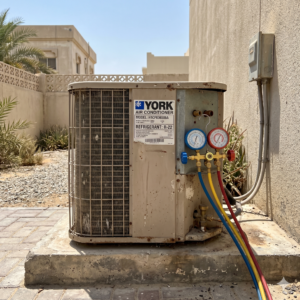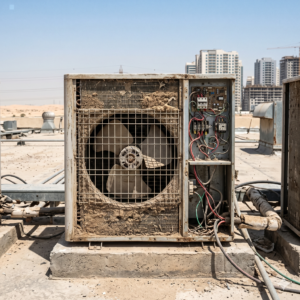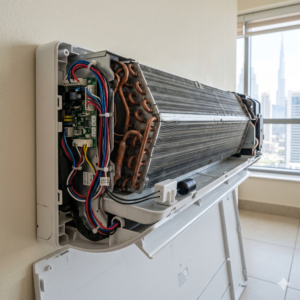





Choosing an energy saving ac in the UAE is not just about comfort—it directly affects your monthly DEWA or SEWA bills. With extreme heat and long AC usage hours, understanding how efficiency ratings, inverter technology, and proper sizing work can help you reduce electricity costs significantly.
Table of Contents
ToggleUnderstanding Energy Efficiency Star Ratings in UAE
In the UAE, air conditioners are regulated with energy efficiency labels that show star ratings. These ratings help you understand how much electricity a unit consumes relative to its cooling capacity.
Generally:
- 1–2 stars: Low efficiency, higher electricity consumption
- 3 stars: Standard efficiency
- 4–5 stars: High efficiency, lower running cost
However, what many people misunderstand is that these ratings are tested under controlled conditions. Real-world usage in Dubai or Sharjah often differs due to extreme heat, dust, and continuous operation.
In practical terms:
- A 5-star AC may reduce electricity usage by 20–40% compared to a 2-star unit
- Savings depend on usage hours, insulation, and room exposure to sunlight
This means a high-rated AC only performs well if the installation and environment are also optimized.
How Energy Saving AC Affects DEWA and SEWA Bills
Electricity bills in the UAE are highly influenced by air conditioning, especially during summer months. AC systems can account for 60–75% of total electricity usage in residential properties.
Let’s break down a simplified comparison:
| AC Type | Monthly Usage (Estimated) | Bill Impact |
|---|---|---|
| Low efficiency AC | High power consumption | Significantly higher bill |
| Energy saving AC | Reduced consumption | Noticeable savings monthly |
Over time, even small efficiency differences can result in large savings.
Inverter vs Non-Inverter AC in UAE Conditions
One of the most important factors in energy saving AC performance is whether the system uses inverter technology.
Non-Inverter AC
- Operates on full power or completely off
- Consumes more electricity due to frequent start-stop cycles
- Less stable temperature control
Inverter AC
- Adjusts compressor speed based on cooling demand
- Maintains stable temperature
- Uses significantly less electricity
In UAE conditions, inverter AC systems can reduce electricity consumption by 30–50% compared to non-inverter units.
This is especially important because AC systems in Dubai often run for long hours daily.
Why T3 Climate Class Compressors Are Critical in UAE
Not all AC units are built for extreme climates. In the UAE, T3 climate class ACs are essential.
T3-rated systems are designed to operate efficiently in temperatures up to 46°C and above.
Without T3 rating:
- Cooling efficiency drops significantly
- Compressor works harder
- Electricity consumption increases
This means even a high-rated AC without T3 capability may perform poorly in real UAE conditions.
Correct AC Sizing for Energy Efficiency
Choosing the right AC size is one of the most overlooked factors in energy saving.
If the AC is too small:
- Runs continuously without reaching target temperature
- Consumes more electricity
If the AC is too large:
- Cycles on and off frequently
- Wastes energy and reduces efficiency
Proper sizing depends on:
- Room size (square meters)
- Ceiling height
- Sun exposure
- Insulation quality
For example:
| Room Size | Recommended Capacity |
|---|---|
| Small room | Low BTU capacity |
| Medium room | Moderate BTU capacity |
| Large room | High BTU capacity |
Incorrect sizing is one of the main reasons energy bills remain high even with efficient AC units.
Return on Investment for Energy Saving AC
Energy-efficient AC units usually cost more upfront, but they offer long-term savings.
Typical scenario:
- Higher upfront cost for inverter AC
- Lower monthly electricity bills
- Payback period within 1–3 years
Over the lifespan of the AC, the total savings often exceed the initial price difference.
Smart Features That Actually Reduce Energy Usage
Modern AC systems include features that help reduce energy consumption when used correctly.
1. Scheduling
Allows you to run AC only when needed.
2. Geofencing
Automatically adjusts cooling when you leave or return home.
3. Smart Thermostat Control
Maintains optimal temperature without overcooling.
These features can improve efficiency, but only if configured properly.
Common Mistakes That Increase Electricity Bills
Many users experience high bills even after buying energy-saving AC units.
Common mistakes include:
- Setting temperature too low (e.g., below 20°C)
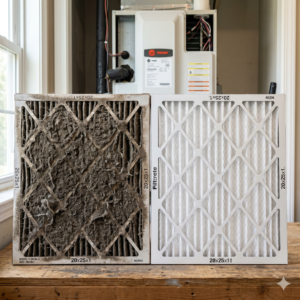
- Not cleaning filters regularly
- Poor insulation or open doors/windows
- Ignoring duct cleaning and airflow issues
In many cases, the problem is not the AC unit, but how it is used and maintained.
Role of Maintenance in Energy Saving
Even the most efficient AC loses performance without proper maintenance.
Regular maintenance helps:
- Keep airflow optimal
- Prevent dust buildup
- Maintain cooling efficiency
Many energy issues are caused by blocked airflow rather than system failure.
Understanding proper AC maintenance practices can help you maintain efficiency over time.
Energy Saving Is a System Approach
Energy efficiency is not just about the AC unit itself. It depends on:
- Correct installation
- Proper sizing
- Regular maintenance
- Smart usage habits
All these factors work together to determine actual energy consumption.
Realistic Expectations from Energy Saving AC
It is important to have realistic expectations. An energy-saving AC will reduce electricity consumption, but it will not eliminate high bills completely.
Factors such as:
- Extreme outdoor temperatures
- Long operating hours
- Property insulation
still influence total energy usage.
When Energy Efficiency Drops Over Time
Even efficient AC systems can lose performance due to:
- Dirty ducts
- Clogged filters
- Refrigerant issues
- Component wear
These factors increase electricity consumption without obvious signs.
If your AC system is not performing efficiently despite being energy-rated, it may not be a problem with the unit itself. Issues like airflow restriction, internal dust buildup, or lack of proper maintenance can significantly increase electricity consumption and reduce cooling performance. Addressing these early can prevent higher bills, poor air quality, and long-term damage. If you need clarity about your AC efficiency or system condition, you can use the WhatsApp or Call button on the top right to connect with the Bio On Air team and understand the most suitable next step.
Conclusion
An energy saving ac in the UAE is only effective when combined with proper sizing, installation, and maintenance. By understanding efficiency ratings, inverter technology, and real usage factors, you can reduce electricity costs while maintaining consistent indoor comfort.