




The dust problem in apartment UAE residents experience is not just about cleaning habits. Even with closed windows, dust keeps returning. This happens due to airflow pressure, fine desert particles, and AC system circulation. In this guide, we explain why dust builds up so fast and how you can actually control it.
Table of Contents
ToggleWhy Dust Builds Up Quickly in UAE Apartments
Many people assume that closing windows should keep dust out. In most countries, that works. But in the UAE, dust behaves differently because of the environment and building structure.
Even in sealed apartments, dust still enters because:
- Buildings are not completely airtight
- Air pressure differences pull air from outside
- Fine desert dust is extremely small and lightweight
- AC systems continuously circulate indoor air
This combination creates a cycle where dust enters, settles, and then gets recirculated again and again.
The Hidden Cause: Negative Air Pressure in High-Rise Buildings
One of the biggest reasons behind the dust problem in apartment environments is something most people do not realize: negative air pressure.
In high-rise buildings, especially in Dubai, the indoor environment is often under slight negative pressure. This means the air inside your apartment is constantly being pulled out faster than it is replaced.
As a result, air from outside is drawn into your apartment through:
- Door gaps
- Window seals
- Electrical outlets
- AC duct leakage points
This incoming air carries fine desert dust, even if your windows are fully closed.
This is why you may notice dust accumulating near door edges or window corners.
Desert Dust vs Normal Household Dust
Not all dust is the same. Understanding the difference helps you choose the right cleaning approach.
| Type of Dust | Source | Characteristics |
|---|---|---|
| Household Dust | Fabric fibers, skin particles | Soft, light, easy to remove |
| Desert Dust | Sand, minerals, silica | Fine, abrasive, persistent |
| Construction Dust | Cement, gypsum | Powdery, heavy, sticks to surfaces |
In UAE apartments, you are often dealing with a mix of all three. Desert dust is especially problematic because it is extremely fine and can pass through basic filtration systems.
Why Dust Still Circulates Even with AC Filters
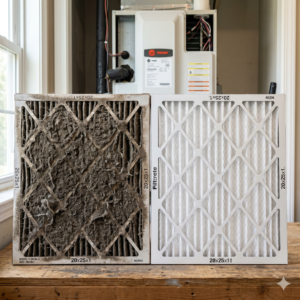
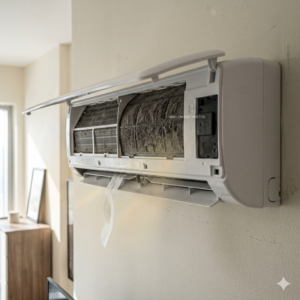
Most AC systems in UAE homes use basic mesh filters. These filters are designed to catch large particles like hair and visible dust, but not fine desert particles.
This means:
- Fine dust passes through the filter
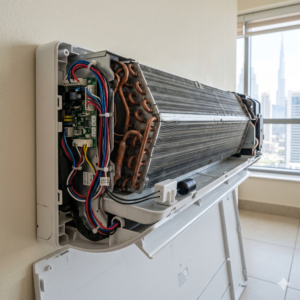
- Dust settles on evaporator coils
- Particles enter the duct system
- Dust is recirculated back into your living space
Over time, the AC system itself becomes a distribution system for dust.
How Dust Builds Up Inside AC Ducts
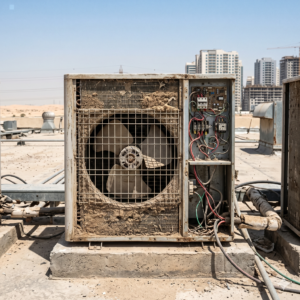
Once dust enters the system, it does not just disappear. It accumulates inside:
- Air ducts
- Cooling coils
- Drain pans
- Blower components
Every time the AC turns on, airflow pushes these particles back into the room.
This is when professional AC deep cleaning or duct cleaning becomes necessary, especially if dust returns quickly after cleaning.
When You Actually Need Professional Duct Cleaning
Not every situation requires professional cleaning, but some clear signs indicate it is necessary:
- Dust appears again within 1–2 days after cleaning
- Visible dust blowing from vents
- Musty or dirty smell from AC
- Allergy symptoms worsen indoors
In these cases, the issue is no longer surface-level—it is inside the system.
Immediate Cleaning Habits That Actually Work
Many cleaning habits make the dust problem worse without realizing it.
Avoid Dry Dusting
Dry cloth cleaning simply lifts dust into the air, allowing it to settle again later.
Use Damp Microfiber Cloths
Damp cloths trap dust instead of spreading it.
Use HEPA Vacuum Cleaners
Standard vacuums release fine dust back into the air. HEPA filters trap microscopic particles effectively.
Clean from Top to Bottom
This prevents recontamination of already cleaned surfaces.
Choosing the Right Air Purifier for UAE Dust
Air purifiers can help, but only if they meet the right specifications.
Important features:
- True HEPA filter (not “HEPA-like”)
- High CADR (Clean Air Delivery Rate)
- Pre-filter for larger dust particles
- Proper room size coverage
Placement Tips
- Near entry points (doors/windows)
- In living rooms with high activity
- Not hidden behind furniture
Proper placement is as important as the purifier itself.
Impact of Construction Activity on Dust
In many UAE areas, ongoing construction significantly increases indoor dust levels.
Construction dust:
- Is finer than normal dust
- Contains cement and gypsum particles
- Travels long distances through air
This type of dust easily enters buildings and settles inside AC systems.
Why Dust in UAE Is More Harmful Than You Think
Desert dust often contains silica, which is abrasive and can damage surfaces over time.
Potential impacts:
- Scratches on glass and furniture
- Wear on electronics
- Reduced AC efficiency
- Respiratory irritation
This is why frequent cleaning alone is not enough—you need proper control.
Interior Design Factors That Make Dust Worse
Some interior elements trap dust and release it repeatedly.
- Carpets and rugs
- Heavy curtains
- Fabric sofas
- Decorative textiles
These materials act as dust reservoirs. Every movement releases particles back into the air.
How to Reduce Dust Accumulation Long-Term
To control dust effectively, you need a combination of strategies:
- Seal gaps around doors and windows
- Upgrade AC filtration where possible
- Maintain regular cleaning routines
- Use air purifiers strategically
- Schedule periodic AC system cleaning
This layered approach is more effective than relying on a single solution.
Why Cleaning Alone Is Not Enough
Many people clean frequently but still experience constant dust buildup. This happens because the source of the dust is not addressed.
Without controlling airflow and internal system contamination, dust will continue to return regardless of cleaning effort.
Think of Dust as a System Problem
In UAE apartments, dust is not just a surface issue—it is a system issue involving airflow, filtration, and environmental conditions.
Understanding this helps you focus on solutions that actually work.
If you are constantly dealing with dust buildup despite regular cleaning, it may indicate deeper issues within your AC system or airflow structure. Dust trapped inside ducts and coils can continuously circulate through your apartment, affecting air quality, increasing energy consumption, and putting extra strain on your AC. Addressing this early helps prevent long-term problems and improves overall indoor comfort. If you need clarity about your situation, you can use the WhatsApp or Call button on the top right to connect with the Bio On Air team and understand the most suitable next step.
Conclusion
The dust problem in apartment UAE residents face is caused by a combination of airflow pressure, fine desert particles, and AC system circulation. By understanding the root causes and applying the right strategies, you can reduce dust buildup and maintain a cleaner, healthier indoor environment.