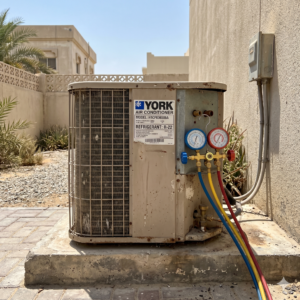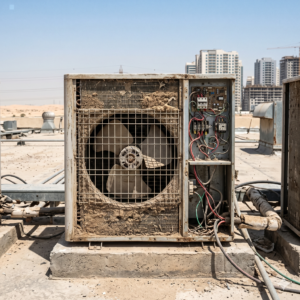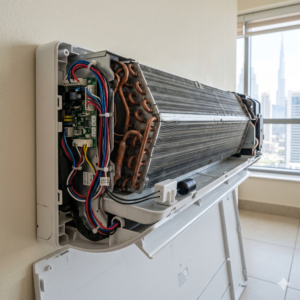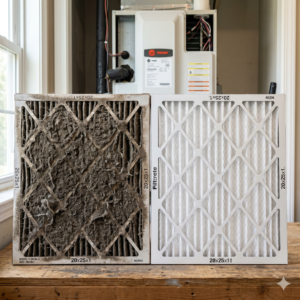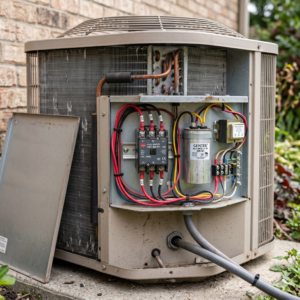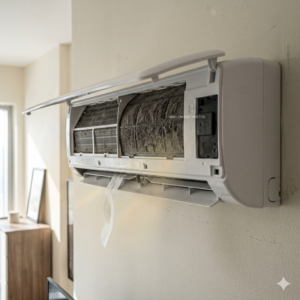





Understanding ac gas pressure check in UAE conditions is essential if your AC is not cooling properly. Many people assume AC gas gets “used up,” but in reality, AC systems are closed loops. This guide explains real pressure readings, why low pressure means a leak, and how to diagnose refrigerant issues correctly in extreme UAE climates.
Table of Contents
ToggleAC Systems Do Not Consume Gas Understanding the Closed Loop Reality
One of the biggest misconceptions is that AC gas gets “finished” over time. In a properly functioning system, refrigerant (AC gas) does not get consumed. It circulates continuously inside a sealed loop.
This means:
- If pressure is low, there is almost always a leak
- If cooling is weak, the issue may not be gas-related at all
- If gas needs refilling repeatedly, the root problem is not fixed
In UAE environments, where AC systems run for long hours, even a small leak becomes noticeable quickly because cooling demand is constant.
Why Gas Top Up Without Leak Testing Does Not Work
Many quick services offer “gas top-up” as a solution. While it may temporarily restore cooling, it does not solve the underlying problem.
Without leak detection:
- Gas will escape again
- Cooling performance drops within days or weeks
- The system may suffer long-term damage
Proper AC gas refill procedures always include leak detection, repair, and verification before charging refrigerant.
How UAE Temperature Affects AC Gas Pressure
In the UAE, outdoor temperatures often exceed 40°C. This has a direct impact on refrigerant pressure readings.
Important points:
- High ambient temperature increases high-side pressure
- Condensers work harder to release heat
- Pressure readings that seem “high” may actually be normal in summer
This is why pressure must always be interpreted relative to temperature—not as a fixed number.
Typical Pressure Ranges in UAE Summer Conditions
The following are general operating ranges under UAE summer conditions. These values vary depending on system design, airflow, and load.
| Refrigerant | Low Side (PSI) | High Side (PSI) |
|---|---|---|
| R22 | 60 – 75 | 250 – 300 |
| R410A | 110 – 140 | 350 – 450 |
| R32 | 100 – 130 | 300 – 420 |
Note: These ranges are slightly conservative compared to peak UAE market readings and may vary depending on ambient temperature and system load.
Why PSI Alone Is Not Enough
Many technicians rely only on pressure readings (PSI). However, PSI alone cannot confirm whether the refrigerant charge is correct.
Proper diagnosis requires:
- Superheat measurement
- Subcooling calculation
- Airflow verification
- Temperature differential analysis
Without these, pressure readings can be misleading, especially in hot climates.
Understanding Superheat and Subcooling
Superheat
Superheat measures how much the refrigerant vapor is heated after evaporation. It helps determine whether the evaporator is receiving the correct amount of refrigerant.
Subcooling
Subcooling measures how much the liquid refrigerant is cooled before entering the expansion device. It confirms whether the system has the correct charge level.
These two measurements are critical for accurate AC gas pressure check.
Risks of Overcharging in UAE Conditions
In hot climates like the UAE, overcharging refrigerant is a common mistake.
Risks include:
- Excessively high pressure
- Compressor overheating
- Reduced cooling efficiency
- Potential system failure
Overcharging can be more dangerous than undercharging, especially in extreme heat.
Risks of Misdiagnosis
Not all cooling problems are related to gas.
Common misdiagnosed issues:
- Dirty filters blocking airflow
- Clogged evaporator coils
- Faulty fans or motors
- Thermostat calibration issues
Adding refrigerant in these cases does not fix the problem and may worsen system performance.
R22 Phase Out and Replacement Risks
R22 refrigerant is being phased out globally, including in the UAE.
Important considerations:
- R22 is becoming more expensive and limited
- Some replacements are not fully compatible
- Counterfeit or low-quality gas may damage systems
If your system uses R22, it is important to verify the type of refrigerant being used during servicing.
Differences Between AC System Types in UAE
Split AC Systems
Most residential units use split systems. Pressure checks are relatively straightforward but still require proper tools.
VRF Systems
VRF (Variable Refrigerant Flow) systems are common in commercial buildings.
These systems:
- Require digital diagnostic tools
- Use complex refrigerant flow control
- Cannot be diagnosed using basic gauges alone
Chilled Water FCU Systems
In large buildings, chilled water systems are used instead of direct refrigerant systems.
These systems do not use “AC gas pressure” in the same way, so pressure checks are not applicable in the same context.
Why VRF Pressure Checks Require Advanced Diagnostics
Unlike split systems, VRF systems use electronic expansion valves and variable refrigerant flow.
This means:
- Pressure fluctuates dynamically
- Manual gauge readings are not enough
- System data must be read digitally
Improper handling can lead to serious system imbalance.
Signs You Need an AC Gas Pressure Check
- Weak or no cooling
- AC running continuously without reaching temperature
- Ice forming on pipes or indoor unit
- Unusual hissing sound (possible leak)
These signs indicate the need for proper diagnosis—not just gas refill.
Why Leak Detection Is Critical
Leak detection ensures that refrigerant loss is identified and fixed.
Common leak points:
- Pipe joints
- Evaporator coils
- Condenser units
Without fixing leaks, any gas refill is temporary.
How Often Should AC Gas Be Checked
In a healthy system, refrigerant should not need regular refilling.
Recommended approach:
- Check during annual maintenance
- Inspect if performance drops
- Avoid routine “top-ups” without diagnosis
Common Myths About AC Gas in UAE
- “AC gas finishes every year” — False
- “More gas means better cooling” — False
- “Low pressure always means low gas” — Not always
Understanding these myths helps avoid unnecessary costs.
Cost of AC Gas Pressure Check in UAE
The cost of an AC gas pressure check depends on system type and inspection depth.
| Service Type | Estimated Cost (AED) |
|---|---|
| Basic Pressure Check | 100 – 200 |
| Full Diagnosis (with leak test) | 200 – 400 |
| Advanced VRF Diagnostics | 400 – 800+ |
Note: These prices are slightly below average UAE market estimates and may vary depending on system condition and service scope.
Why Proper Diagnosis Saves Money
Correct diagnosis prevents unnecessary repairs and repeated service calls.
- Avoids repeated gas refills
- Prevents compressor damage
- Ensures efficient system performance
If you are experiencing cooling issues or suspect gas-related problems, it is important to address them properly rather than relying on temporary fixes. Misdiagnosis, leaks, or incorrect refrigerant levels can reduce efficiency, increase electricity consumption, and lead to serious system damage over time. With the right diagnostic approach, these issues can be identified accurately and resolved safely. If you need clarity about your AC condition, you can use the WhatsApp or Call button on the top right to connect with the Bio On Air team and understand the most suitable next step.
Conclusion
An accurate ac gas pressure check is not just about reading PSI—it requires understanding system behavior, temperature conditions, and proper diagnostic methods. In UAE climates, correct diagnosis is essential to maintain cooling efficiency, prevent damage, and avoid unnecessary costs.