




What is AC duct is a question many homeowners ask when cooling feels uneven, air quality drops, or energy bills rise without a clear reason. The simplest way to understand an AC duct system is to think of it like the circulatory system in your body: ducts act as the pathways that move conditioned air from the AC unit to each room and carry used air back to be cooled again. Even if your AC unit itself is powerful, the system cannot work properly if these air pathways are poorly designed, damaged, or dirty.
Table of Contents
ToggleWhat Is an AC Duct Explained in Simple Terms
An AC duct is a network of passages—usually hidden behind ceilings, walls, or floors—that distributes cooled (or heated) air throughout a home or building. When your air conditioner produces cool air, that air does not enter rooms directly from the unit. Instead, it travels through ducts until it reaches each space.
Using the circulatory-system analogy, your AC unit is like the heart, while ducts are the arteries and veins. The ducts deliver fresh, conditioned air to rooms and then return the used air back to the system. Without ducts, air would stay trapped in one place, and temperature control across multiple rooms would not be possible.
This is why understanding what an AC duct is helps homeowners see that comfort problems are not always caused by the AC machine itself. Very often, the issue lies in how air moves—or fails to move—through the duct system.
How an AC Duct System Works Inside a Home
An AC duct system works as a continuous loop. The AC unit cools the air, sends it through ducts, and then pulls the air back after it circulates in rooms. This cycle repeats many times a day.
Here is the basic flow:
- The AC unit cools the air.
- Cooled air travels through supply ducts.
- Air enters rooms through vents.
- Used air is pulled back through return ducts.
- Air returns to the AC unit to be cooled again.
If any part of this loop is blocked, leaking, or poorly designed, the entire system becomes less effective. Rooms may feel too warm, airflow may feel weak, or the AC may run longer than necessary.
AC Duct System Anatomy Explained Clearly
To fully understand what an AC duct is, it helps to break the system into its main parts. Each part has a specific role in keeping air moving correctly.
Main Trunk Lines
Main trunk lines are the largest ducts in the system. They act like highways for air movement. These ducts carry large volumes of conditioned air from the AC unit toward different sections of the home.
Because they handle the highest airflow, trunk lines are usually hidden above ceilings or in service spaces. Problems here—such as leaks or poor insulation—can affect multiple rooms at once.
Supply Duct Paths
Supply ducts branch off from the main trunk lines and deliver cooled air to individual rooms. These are like smaller roads that direct air where it is needed.
If supply ducts are poorly sized or damaged, some rooms may receive too much air while others get very little. This often leads to uneven temperatures within the same home.
Return Duct Paths
Return ducts are responsible for carrying used air back to the AC unit. Many homeowners focus only on air coming out of vents, but returns are just as important.
Without proper return airflow, pressure builds up in rooms. This can reduce cooling efficiency and strain the AC system. In simple terms, air must leave a room for new air to enter effectively.
Visible Vents and Grilles
Vents and grilles are the only parts of the duct system most homeowners see. Supply vents release cool air into rooms, while return grilles pull air back.
Although they look simple, their placement and condition matter. Blocked or closed vents can disrupt airflow across the entire system.
Common AC Duct Materials Found in Homes
Another important part of understanding what an AC duct is involves knowing what ducts are made of. Different materials have different strengths, limitations, and visual characteristics.
Sheet Metal Ducts
Sheet metal ducts are usually made of galvanized steel or aluminum. They are rigid, durable, and often found in long-lasting installations.
You can recognize sheet metal ducts by their solid, smooth surface and rectangular or round shape. They are generally resistant to physical damage but may require insulation to prevent energy loss.
Flexible Ducts
Flexible ducts are made from a wire coil covered with plastic and insulation. They are easy to install and commonly used in residential homes.
Visually, flexible ducts look like silver or gray tubes. While convenient, they can sag, bend, or tear if not installed properly, which restricts airflow.
Fiberglass Duct Board
Fiberglass duct board ducts are rigid panels made from compressed fiberglass. They often have a textured surface.
These ducts provide built-in insulation and reduce noise, but they can trap dust if damaged and may be more sensitive to moisture issues.
Why AC Ducts Matter to Comfort and Efficiency
Many homeowners focus on the AC unit itself when comfort drops. However, ducts play a major role in how well the system performs.
Energy Loss from Leaks
When ducts have leaks or poor connections, conditioned air escapes before reaching rooms. This means the AC must run longer to achieve the same cooling result.
Even small leaks can have noticeable effects over time. If your AC seems to work harder without improving comfort, duct leakage may be a contributing factor.
Uneven Room Temperatures
If some rooms are always warmer or cooler than others, duct design or condition is often the cause. Restricted airflow, poor balancing, or damaged ducts can prevent air from reaching certain spaces evenly.
Indoor Air Quality Risks
Ducts also affect the air you breathe. Dust, moisture, and contaminants inside ducts can circulate through your home.
This can contribute to unpleasant odors, allergy symptoms, or a feeling that the air is stale, even when the AC is running.
System Strain and Wear
When ducts do not move air efficiently, the AC system compensates by running longer or cycling more frequently. Over time, this adds strain to components and increases the likelihood of breakdowns.
Simple Checks Homeowners Can Safely Do
You do not need to be a technician to notice early signs of duct issues. There are a few safe, simple checks homeowners can perform.
Feel for Air Leaks
Place your hand near visible duct connections or vents while the AC is running. If you feel air escaping where it should not, there may be a leak.
Check Filter Placement
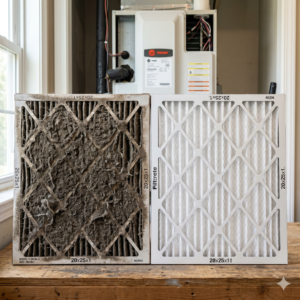
Make sure air filters are properly installed and clean. A clogged filter restricts airflow and can exaggerate duct-related problems.
Avoid Excessive Vent Closure
Closing too many vents may seem like a way to save energy, but it often increases pressure in ducts and reduces system efficiency.
Common Warning Signs of AC Duct Problems
Understanding what an AC duct is also means recognizing when something is wrong.
- Weak airflow: often indicates blockages, leaks, or crushed ducts.
- Unusual noises: rattling or whistling sounds can point to loose connections.
- Persistent dust: may suggest duct leaks pulling in contaminants.
- Uneven cooling: commonly linked to poor duct design or damage.
These signs usually mean the duct system needs attention, not just the AC unit.
Why Visual Diagrams and Walkthroughs Help Homeowners
AC ducts are mostly hidden, which makes them hard to understand. Visual diagrams and simple walkthroughs help homeowners see how air moves and where problems might occur.
When you understand the basic layout of your duct system, you can communicate more clearly with technicians, ask better questions, and make informed decisions about maintenance or repair.
This knowledge reduces uncertainty and helps ensure that solutions address the real cause, not just the visible symptom.
When Duct Issues Should Be Addressed Properly
Duct problems rarely fix themselves. Over time, they can reduce comfort, lower indoor air quality, increase system strain, and lead to higher energy use. Addressing duct-related concerns early helps maintain consistent cooling, cleaner air, and smoother system operation. If you are unsure whether ducts are affecting your AC performance, an informed discussion with a professional can clarify the next step.
Conclusion
Understanding what is AC duct helps homeowners see the bigger picture behind cooling performance and indoor comfort. Ducts are the hidden pathways that distribute conditioned air and return used air to the system, much like a circulatory system. When ducts are well-designed and well-maintained, your AC works efficiently and evenly. When they are damaged or neglected, comfort and air quality suffer.
By knowing the basic anatomy, materials, warning signs, and simple checks, homeowners can better understand their systems and communicate confidently with technicians. This awareness makes it easier to address issues early, avoid unnecessary repairs, and maintain a healthier, more comfortable indoor environment.