




Many people wonder why AC temperature is not below 16 when they feel the room is still not cold enough, especially during very hot days. You may lower the setting to the minimum, yet the air does not feel significantly colder, or the AC simply refuses to go below a certain limit. This situation is common, confusing, and often leads to unnecessary worry about whether the AC is broken. In reality, there are technical, safety, efficiency, and design reasons behind this behavior, and understanding them helps you use your AC more effectively and avoid costly mistakes.
Table of Contents
ToggleHow AC Temperature Settings Actually Work
To understand why AC temperature is not below 16, it is important to first understand what the temperature setting really means. The number on your remote is not a direct measure of how cold the air coming out of the AC is. Instead, it is a target room temperature.
When you set the AC to 16°C, you are telling the system: “keep cooling the room until the sensor believes the room temperature has reached around 16°C.” The AC does not blow colder air just because you lower the number further. Most residential AC systems are designed to produce supply air within a fixed temperature range that is safe and efficient for the system.
This means that setting the AC to 16°C does not make it work harder than setting it to 18°C. It only changes how long the system runs before it cycles or stabilizes.
The Technical Limit of Residential AC Systems
One of the main reasons why AC temperature is not below 16 is the technical limitation of residential cooling systems. Most split AC and central AC units are designed to cool indoor air to a safe minimum range without risking damage.
If an AC were allowed to cool indefinitely:
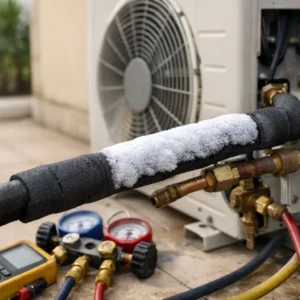
- The evaporator coil could freeze.
- Airflow could be blocked by ice buildup.
- The compressor could overwork and fail.
- Energy consumption would increase dramatically.
To prevent this, manufacturers set a lower limit—commonly 16°C—as a balance between comfort and system protection. This limit protects internal components and ensures stable operation.
Why Cooling Below 16°C Is Not Practical Indoors
Even if it were technically possible, cooling a typical indoor space below 16°C is not practical or healthy in most environments.
In hot climates like the UAE, indoor temperatures that are too low can cause:
- Thermal shock when moving between indoor and outdoor spaces.
- Respiratory discomfort and dry air issues.
- Increased condensation on surfaces.
- Higher risk of mold growth due to moisture imbalance.
AC systems are designed for comfort cooling, not refrigeration. The goal is to create a stable, comfortable indoor environment, not an artificially cold one.
Sensor Placement and Perceived Cooling
Another reason why AC temperature is not below 16 is related to how the system senses temperature. AC units rely on internal sensors, usually located near the indoor unit intake.
If:
- The sensor is close to the cooling coil,
- Airflow is uneven,
- Cold air circulates poorly in the room,
the AC may believe the room has reached the target temperature even if you personally still feel warm. This creates the impression that the AC is “not cooling enough,” even though it is operating as designed.
Airflow Problems That Affect Cooling Performance
When people ask why AC temperature is not below 16, the real issue is often not temperature control but airflow.
Poor airflow can happen due to:
- Dirty or clogged air filters.
- Dust buildup on coils.
- Blocked or poorly designed ducts.
- Closed or obstructed vents.
When airflow is restricted, cold air cannot spread evenly. The AC works longer, but the room never feels as cool as expected. Lowering the temperature setting does not fix this problem.
Why Setting AC to 16°C Does Not Cool Faster
A very common misconception is that setting the AC to the lowest temperature will cool the room faster. This is not true.
AC systems typically run at a fixed cooling capacity. Whether you set the temperature to 16°C or 22°C, the system cools at the same rate. The only difference is how long it keeps running.
This misunderstanding often leads to unnecessary strain on the system and higher electricity bills without improving comfort.
The Role of Humidity in Cooling Comfort
Another important factor often overlooked when discussing why AC temperature is not below 16 is humidity.
High humidity makes the air feel warmer, even at lower temperatures. If humidity is not controlled properly:
- The room feels sticky or heavy.
- Sweat does not evaporate efficiently.
- Cooling feels less effective.
In many cases, improving humidity control makes the room feel cooler without lowering the temperature further.
Room Size and AC Capacity Mismatch
If your AC cannot cool the room effectively even at 16°C, the problem may be system sizing.
An AC that is too small for the room will:
- Run continuously.
- Struggle during peak heat.
- Never reach the target temperature.
This leads people to believe the AC temperature is limited, when in fact the system capacity is insufficient for the space.
Heat Load from Sunlight and Appliances
External heat sources play a major role in perceived cooling.
Factors that increase heat load include:
- Direct sunlight through windows.
- Poor insulation.
- Heat-generating appliances.
- High occupancy levels.
When heat enters the room faster than the AC can remove it, lowering the temperature setting has little effect.
Why AC Manufacturers Set 16°C as the Minimum
Manufacturers choose 16°C as a standard lower limit based on:
- System safety.
- Energy efficiency standards.
- Human comfort research.
- Long-term reliability.
This limit ensures the AC operates within a range that balances comfort and durability.
Common Myths About AC Temperature Limits
There are several myths around why AC temperature is not below 16:
- Myth: Lower settings mean colder air.
Reality: Air temperature output is relatively fixed. - Myth: ACs are restricted by software only.
Reality: Limits protect physical components. - Myth: Forcing lower temperatures improves cooling.
Reality: It increases wear without benefits.
Signs Your AC Is Working Normally
Even if the temperature does not go below 16, your AC may be functioning correctly if:
- The air from vents feels cool.
- The system cycles normally.
- There is no ice buildup.
- Energy consumption is stable.
When Limited Cooling Indicates a Real Problem
Sometimes, the question why AC temperature is not below 16 hides a deeper issue.
Warning signs include:
- Warm air from vents.
- Water leakage.
- Unusual noises.
- Rapid temperature fluctuation.
In these cases, professional inspection is recommended.
How Professional Inspection Helps Identify the Real Cause
A professional AC inspection looks beyond temperature settings. It evaluates airflow, refrigerant levels, electrical components, and system balance.
This approach ensures the real cause of poor cooling is addressed instead of guessing based on temperature numbers alone.
How to Improve Cooling Without Lowering Temperature
There are several effective ways to improve comfort without pushing the AC below 16°C:
- Clean or replace filters regularly.
- Improve airflow distribution.
- Reduce heat sources.
- Use curtains or window films.
- Schedule periodic maintenance.
When AC Problems Should Be Handled Properly
AC systems that struggle to cool efficiently often affect indoor air quality, energy usage, and long-term system health. When issues are ignored, they can lead to higher electricity bills, recurring breakdowns, and unhealthy indoor conditions. Bio On Air helps address these problems through proper inspection, airflow assessment, and safe repair methods. Acting early helps prevent small issues from becoming costly system failures. You can use the WhatsApp or Call button at the top right of this page to discuss your AC performance concerns with our team.
Conclusion
Understanding why AC temperature is not below 16 helps remove unnecessary frustration and prevents misuse of your cooling system. This limit exists to protect the AC, ensure efficiency, and maintain healthy indoor comfort. In most cases, poor cooling is not caused by the temperature setting itself, but by airflow issues, humidity, system sizing, or heat load.
Instead of forcing the AC to its lowest setting, focus on improving system condition and room environment. When cooling still feels insufficient, a proper inspection can identify the real cause. With the right approach, your AC can deliver reliable comfort without unnecessary strain, higher costs, or repeated breakdowns.