




Split ac vs window ac power consumption is one of the most common questions people ask when choosing an air conditioner for a home or office. The confusion usually comes from mixed advice: some say split AC is always more efficient, others claim window AC is cheaper to run. The reality is more nuanced. Power consumption depends on usage patterns, room size, climate, insulation, and how the AC is maintained. This article breaks down the comparison in depth, explains real-world energy behavior, and uses clear simulation examples so you can estimate actual running costs instead of relying on assumptions.
Table of Contents
ToggleUnderstanding Power Consumption in Air Conditioners
Before comparing split AC and window AC, it is important to understand what “power consumption” actually means. Power consumption refers to how much electrical energy an AC uses over time, usually measured in kilowatt-hours (kWh). Your electricity bill is based on kWh, not just how powerful the AC feels.
Several factors affect AC power consumption:
- Cooling capacity (measured in tons or BTU)
- Compressor efficiency
- Usage duration per day
- Thermostat settings
- Room insulation and heat load
- Maintenance condition (filters, coils, airflow)
This means comparing split ac vs window ac power consumption is not just about the unit type, but how each system behaves under the same conditions.
Basic Difference Between Split AC and Window AC
At a basic level, both split AC and window AC perform the same function: removing heat from indoor air and releasing it outside. The difference lies in design and component layout.
- Window AC: A single compact unit installed in a window or wall opening. All components (compressor, condenser, evaporator) are housed together.
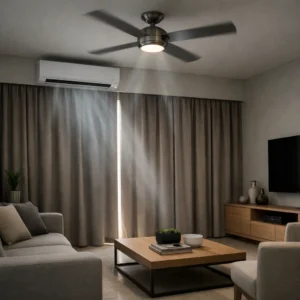
- Split AC: Two separate units—an indoor unit and an outdoor unit—connected by refrigerant pipes. The compressor and condenser are located outside.
This structural difference directly affects noise, cooling stability, airflow control, and energy efficiency.
Rated Power Consumption: Split AC vs Window AC
Manufacturers usually specify rated power consumption under standardized test conditions. Below is a typical comparison for commonly used residential AC capacities.
| AC Type | Capacity | Average Rated Power | Efficiency Trend |
|---|---|---|---|
| Window AC | 1.0 ton | 900–1,100 W | Moderate |
| Split AC (non-inverter) | 1.0 ton | 800–1,000 W | Better than window |
| Split AC (inverter) | 1.0 ton | 500–800 W (variable) | High efficiency |
| Window AC | 1.5 ton | 1,400–1,600 W | Moderate |
| Split AC (inverter) | 1.5 ton | 900–1,200 W (variable) | High efficiency |
On paper, split AC—especially inverter models—consume less power on average. However, real-world usage often differs from rated values.
Why Split AC Usually Consumes Less Power Over Time
The main reason split AC tends to be more energy-efficient lies in how it controls the compressor.
Most modern split AC units use inverter technology. Instead of turning the compressor fully on and off repeatedly, the inverter adjusts compressor speed based on cooling demand. Once the room reaches the set temperature, the compressor slows down rather than stopping.
This leads to:
- Lower peak power draw
- More stable indoor temperature
- Reduced energy spikes
- Less wear on components
Window AC units are often non-inverter models. They cycle on and off more frequently, which increases power draw during startup and leads to higher average consumption over long hours.
When Window AC Can Be More Power-Efficient
Despite the general trend, there are scenarios where a window AC can consume similar or even less power than a split AC.
- Short usage duration (1–2 hours at a time)
- Small rooms with minimal heat load
- Occasional cooling rather than daily use
- Well-maintained high-efficiency window AC
In such cases, the simplicity of a window AC and lower initial power draw may offset the advantages of inverter-based split systems.
Simulation: Daily Power Consumption Comparison
To understand split ac vs window ac power consumption more realistically, let us simulate common use cases.
Scenario 1: Bedroom Use (1.0 Ton AC)
Assumptions:
- Room size: 120 sq ft
- Usage: 8 hours per night
- Electricity rate: AED 0.30 per kWh
- Outdoor temperature: High (typical UAE summer)
| AC Type | Avg Power Draw | Daily Consumption | Monthly Cost (30 days) |
|---|---|---|---|
| Window AC | 1.0 kW | 8 kWh | AED 72 |
| Split AC (inverter) | 0.7 kW | 5.6 kWh | AED 50.4 |
Over a month, the split AC saves around AED 21.6 in this scenario.
Scenario 2: Living Room Use (1.5 Ton AC)
Assumptions:
- Room size: 250 sq ft
- Usage: 10 hours per day
- Electricity rate: AED 0.30 per kWh
| AC Type | Avg Power Draw | Daily Consumption | Monthly Cost |
|---|---|---|---|
| Window AC | 1.5 kW | 15 kWh | AED 135 |
| Split AC (inverter) | 1.1 kW | 11 kWh | AED 99 |
In high-usage environments, split AC shows clearer cost advantages.
Impact of Temperature Settings on Power Consumption
One of the biggest hidden factors in split ac vs window ac power consumption is thermostat behavior.
Lowering the temperature from 24°C to 20°C can increase power usage by 20–30%, regardless of AC type. Split AC handles this more gracefully because it modulates compressor speed, while window AC runs at full load for longer periods.
Setting the thermostat between 24–26°C often delivers the best balance between comfort and efficiency.
Noise, Comfort, and Indirect Energy Effects
Comfort affects energy usage indirectly. Window AC units are noisier because the compressor is inside the room. Many users lower the temperature more than necessary to “feel” stronger cooling, increasing power consumption.
Split AC units operate more quietly, allowing users to maintain moderate settings without overcooling, which helps reduce unnecessary energy use.
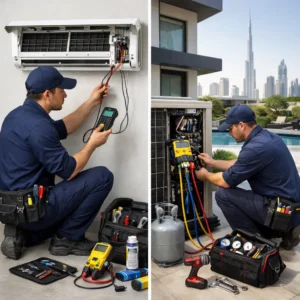
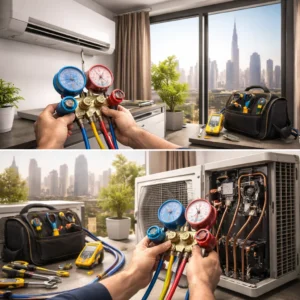
Maintenance and Its Effect on Power Consumption
Maintenance plays a critical role in actual energy usage.
- Dirty filters reduce airflow and increase compressor workload
- Dusty coils reduce heat exchange efficiency
- Blocked drain lines affect humidity control
Both split and window AC units can lose 10–25% efficiency if not maintained regularly. However, split AC systems benefit more from proper maintenance because inverter efficiency relies heavily on clean airflow and stable heat transfer.
Long-Term Cost Comparison
While split AC units often have higher upfront costs, their lower operating cost can offset the difference over time.
| Factor | Window AC | Split AC |
|---|---|---|
| Initial Cost | Lower | Higher |
| Monthly Power Cost | Higher | Lower |
| Noise Level | High | Low |
| Long-Term Efficiency | Moderate | High |
Which One Is Better for Your Use Case
Choose window AC if:
- You need cooling occasionally
- The room is small
- Initial cost is a priority
Choose split AC if:
- You run AC for long hours daily
- You want stable temperature and lower noise
- You care about long-term electricity savings
Conclusion
When comparing split ac vs window ac power consumption, there is no single answer that fits everyone. Split AC systems, especially inverter models, are generally more energy-efficient over long hours and high usage, while window AC units can be practical for short, occasional cooling needs.
The real key is matching the AC type to your usage pattern, room size, and maintenance habits. Understanding how power consumption behaves in real conditions—not just manufacturer ratings—helps you avoid higher bills and uncomfortable surprises. With the right choice and proper care, both systems can deliver efficient cooling without unnecessary energy waste.