




Searching for refrigerant leak detector price usually means one thing: you suspect a refrigerant leak and want to understand how much it will really cost to find it and fix it. This can be confusing because prices vary widely—from low-cost DIY detectors to professional-grade tools and full technician services. The real challenge for most readers is not just the price of a tool, but deciding whether buying a detector makes sense at all, or if paying for professional leak detection is actually the safer and more cost-effective option.
Table of Contents
ToggleWhat Is a Refrigerant Leak Detector and Why It Matters
A refrigerant leak detector is a tool used to locate leaks in an HVAC or AC system where refrigerant gas escapes. Even a small leak can cause weak cooling, higher electricity consumption, frequent compressor cycling, and long-term damage to the system.
Many people underestimate refrigerant leaks because the system may still run. However, refrigerant does not get “used up.” If levels drop, it almost always means gas is escaping somewhere. Finding the leak accurately is critical before refilling refrigerant; otherwise, the same problem returns and costs increase over time.
Refrigerant Leak Detector Price Overview
When people search for refrigerant leak detector price, they often see a very wide range of numbers. This is because leak detectors differ greatly in technology, accuracy, durability, and intended use.
Broadly, refrigerant leak detector prices fall into three categories:
- DIY / consumer-grade detectors
- Mid-range semi-professional detectors
- Professional HVAC-grade detectors
Understanding these categories helps you compare costs realistically instead of assuming all detectors perform the same function.
DIY Refrigerant Leak Detector Price Range
DIY refrigerant leak detectors are usually designed for occasional home use or basic checks. They are often marketed online as affordable solutions for homeowners.
Typical price range:
- USD 20–60 (approximately AED 75–220)
What you usually get at this price:
- Basic electronic sensor
- Audible beep or simple LED alert
- Limited sensitivity
- Plastic housing with minimal protection
Limitations to be aware of:
- May struggle to detect very small or slow leaks
- Higher chance of false positives
- Less reliable in hot, humid, or dusty environments
- Shorter lifespan with frequent use
DIY detectors can sometimes help confirm a large leak, but they are not always reliable for pinpointing exact leak locations, especially in complex systems.
Mid-Range Refrigerant Leak Detector Price Range
Mid-range detectors are often used by serious DIY users, maintenance staff, or technicians who need better accuracy without investing in top-tier equipment.
Typical price range:
- USD 80–200 (approximately AED 300–740)
Features commonly included:
- Improved sensor sensitivity
- Adjustable sensitivity settings
- Visual and audible alerts
- Better refrigerant compatibility
Trade-offs:
- More accurate than DIY tools, but still not laboratory-level precision
- Requires correct technique to avoid misreading
- Not always ideal for deeply concealed or micro-leaks
For some users, this price range seems attractive. However, it still assumes the user understands how to interpret readings and confirm results.
Professional Refrigerant Leak Detector Price Range
Professional-grade leak detectors are designed for daily HVAC use, complex systems, and accurate diagnosis.
Typical price range:
- USD 250–1,000+ (approximately AED 920–3,700+)
What makes them expensive:
- Very high sensitivity capable of detecting tiny leaks
- Stable readings with minimal false alarms
- Durable construction for harsh environments
- Wide refrigerant compatibility (R22, R410A, R32, etc.)
These tools are designed to reduce guesswork and speed up diagnostics. However, the cost only makes sense if the tool is used frequently and by someone trained to interpret results correctly.
How Detection Technology Affects Refrigerant Leak Detector Price
One major reason prices vary is detection technology. Different technologies offer different levels of accuracy and reliability.
Electronic Heated Diode Detectors
These are common in mid to high-end detectors.
- Moderate to high sensitivity
- Works well for many refrigerants
- Price: usually mid-range
Infrared (IR) Leak Detectors
Infrared detectors are among the most accurate.
- Detects refrigerant molecules via infrared absorption
- Very low false positives
- Price: high-end professional range
Ultrasonic Leak Detection
Used for detecting the sound of escaping gas.
- Useful in noisy environments
- Less affected by airflow
- Requires experience to interpret
The more advanced the technology, the higher the refrigerant leak detector price tends to be.
Accuracy and Sensitivity: Why Cheap Tools Can Cost More Later
One of the biggest pain points for users is buying a cheap detector, failing to find the leak, and then paying for professional service anyway.
Low sensitivity means:
- Leaks are missed
- Refrigerant is refilled without fixing the leak
- The system loses gas again
- Total cost increases
In this situation, the initial low tool price becomes irrelevant compared to repeated refrigerant refills and system stress.
Buying a Refrigerant Leak Detector vs Hiring a Professional
When considering refrigerant leak detector price, it is important to compare it with professional leak detection services.
Cost of Professional Leak Detection Services
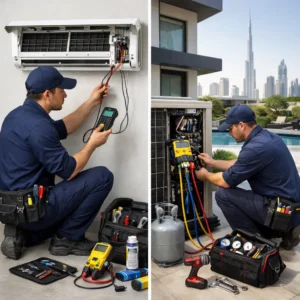
Professional HVAC leak detection usually includes:
- System inspection
- Leak detection using professional tools
- Clear identification of leak location
Typical diagnostic and leak search fees:
- AED 150–450 for inspection and diagnosis
- Higher for complex or commercial systems
This fee often covers expertise, not just tool usage.
When Buying a Detector Makes Sense
Buying a refrigerant leak detector may make sense if:
- You manage multiple systems
- You perform regular HVAC maintenance
- You have technical knowledge and experience
For one-time or occasional issues, professional services are often more cost-effective.
Total Cost to Find and Fix a Refrigerant Leak
Many readers want to know the full cost, not just the detector price.
Typical total cost breakdown:
- Leak detection and diagnosis: AED 150–450
- Leak repair (minor to moderate): AED 300–1,200
- Refrigerant refill: AED 230–450 (depending on refrigerant type)
Total estimated cost:
- AED 680–2,100 for common residential cases
Severe leaks or major component damage can push costs higher, especially if compressors or coils are affected.
Factors That Cause Wide Price Differences
Several factors influence refrigerant leak detector price:
- Accuracy: higher sensitivity means higher cost
- Durability: rugged tools last longer
- Refrigerant compatibility: multi-gas support costs more
- Environmental stability: performance in heat and humidity
- Brand and certification: tested reliability
Common Mistakes When Choosing Based on Price Alone
Focusing only on price can lead to:
- Buying tools that give false confidence
- Missing slow or hidden leaks
- Refilling refrigerant without fixing the problem
- Higher long-term repair costs
Understanding these risks helps frame price as part of a bigger decision, not the decision itself.
When Professional Leak Detection Is the Smarter Choice
Hiring a professional is usually the better option when:
- The system has lost refrigerant more than once
- The leak location is not obvious
- The system is large or complex
- Indoor air quality or safety is a concern
Professionals combine tools, experience, and judgment to avoid unnecessary costs.
Conclusion
The search for refrigerant leak detector price is really about understanding total cost and risk. While detectors range from low-cost DIY tools to expensive professional equipment, the cheapest option is not always the most economical in the long run.
For occasional use, professional leak detection often provides better value by identifying the problem correctly the first time. Buying a detector makes sense mainly for frequent users with the skills to use it effectively. By focusing on accuracy, reliability, and total cost—not just tool price—you can make a smarter decision and protect your HVAC system from repeated damage and unnecessary expense.