




R410 gas pressure is one of the most important parameters for understanding how modern air conditioning systems operate, troubleshoot problems, and maintain safe performance. Whether you are a technician, facility manager, or informed AC owner, knowing how R410A pressure behaves under normal and abnormal conditions helps you avoid misdiagnosis, prevent system damage, and ensure efficient cooling. Because R410A operates at significantly higher pressures than older refrigerants, pressure readings must always be interpreted with proper context, temperature awareness, and safety discipline.
Table of Contents
ToggleWhat Is R410A and Why Its Pressure Is Different
R410A is a high-pressure refrigerant commonly used in modern split AC systems, VRF units, and heat pumps. It replaced older refrigerants such as R22 due to better efficiency and lower ozone impact. However, one critical difference is operating pressure.
Compared to R22, R410A runs at much higher pressures on both the low side and high side. This is not a flaw—it is part of the refrigerant’s thermodynamic design. Higher pressure allows better heat transfer and efficiency, but it also means that tools, procedures, and safety practices must be adjusted accordingly.
This is why understanding r410 gas pressure cannot be reduced to a single number. Pressure must always be evaluated together with temperature, system condition, and operating mode.
Normal R410 Gas Pressure Ranges (Operating Conditions)
Under normal operation, R410A pressure will vary depending on ambient temperature, indoor load, airflow, and system design. However, there are typical pressure ranges that serve as a baseline reference.
Low Side (Suction Pressure)
The low side pressure represents the refrigerant returning to the compressor after absorbing heat from the indoor air.
- Typical operating range: 115–145 psi
- Common evaporating temperature equivalent: ~40–50°F (4–10°C)
Low side pressure is strongly influenced by indoor airflow, evaporator cleanliness, and refrigerant charge. A reading outside this range does not automatically mean a gas problem—it must be interpreted carefully.
High Side (Discharge Pressure)
The high side pressure reflects the refrigerant leaving the compressor and releasing heat through the condenser.
- Typical operating range: 350–450 psi
- Can exceed 500 psi in very hot ambient conditions
High side pressure is heavily affected by outdoor temperature, condenser airflow, and heat rejection efficiency. Hot climates like the UAE naturally push high side pressure higher than cooler regions.
Static Pressure (System Off)
Static pressure is measured when the system is off and refrigerant pressure equalizes throughout the circuit.
- At ~75°F (24°C): ~225–235 psi
- Static pressure rises and falls directly with ambient temperature
Static pressure alone cannot confirm charge accuracy, but it can help identify major leaks or gross overcharging.
Pressure–Temperature Relationship in R410A
One of the most important concepts in understanding r410 gas pressure is the pressure–temperature (PT) relationship. R410A is a near-azeotropic blend, meaning its pressure corresponds very closely to saturation temperature.
This relationship allows technicians to:
- Estimate evaporator and condenser temperatures from pressure readings
- Calculate superheat and subcooling accurately
- Detect abnormal system behavior beyond simple pressure numbers
Example of Pressure–Temperature Behavior
- 120 psi ≈ 41°F saturation temperature
- 145 psi ≈ 50°F saturation temperature
- 400 psi ≈ 120°F saturation temperature
This means pressure must always be interpreted alongside temperature measurements taken at the correct locations. Reading pressure alone without temperature data often leads to incorrect conclusions.
Why Ambient Temperature Changes Pressure Readings
Many misdiagnoses happen because ambient temperature is ignored. In hot climates, both suction and discharge pressures will naturally run higher.
Key factors affecting pressure:
- Outdoor ambient temperature
- Indoor heat load
- Condenser airflow
- Evaporator airflow
For example, a high side pressure of 460 psi may be normal on a very hot afternoon but abnormal on a mild day. This is why manufacturer pressure charts and PT tables should always be referenced.
Safety Considerations with R410 Gas Pressure
R410A’s higher operating pressure introduces specific safety risks if handled incorrectly.
Why R410A Is More Demanding Than R22
- Operating pressure is ~50–70% higher than R22
- Sudden pressure release can be violent
- Component failure under pressure can cause serious injury
Because of this, using outdated tools or incorrect procedures is extremely dangerous.
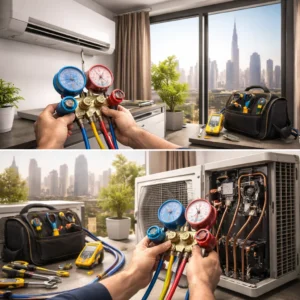
Required Gauge and Equipment Compatibility
All tools used on R410A systems must be rated for high pressure.
- Manifold gauges rated for at least 800 psi high side
- Hoses rated for R410A pressure
- Recovery machines and cylinders designed for high pressure refrigerants
Never use R22-rated gauges or hoses on R410A systems. Failure of equipment under pressure can result in injury or property damage.
Using R410 Gas Pressure for Advanced Diagnostics
Professional diagnostics go far beyond checking whether pressure is “high” or “low.” Pressure readings become powerful when combined with temperature data.
Superheat Calculation
Superheat indicates how much the refrigerant vapor is heated above its saturation temperature at the evaporator outlet.
- Used mainly on fixed-orifice systems
- Helps determine correct refrigerant charge
- Indicates evaporator feeding efficiency
Low superheat may indicate overfeeding or airflow issues. High superheat may indicate undercharge or restriction.
Subcooling Calculation
Subcooling measures how much the liquid refrigerant is cooled below saturation temperature at the condenser outlet.
- Primary method for TXV systems
- Used to confirm proper refrigerant charge
- More reliable than pressure-only diagnostics
Incorrect subcooling values often point to overcharge, undercharge, or condenser inefficiency.
Interpreting Abnormal R410 Gas Pressure Readings
Pressure readings become meaningful when patterns are recognized. Below are common scenarios and what they often indicate.
Low Suction Pressure + Low Discharge Pressure
- Possible refrigerant undercharge
- Leak in the system
- Restricted refrigerant flow
This condition often results in poor cooling and higher compressor stress.
Low Suction Pressure + High Discharge Pressure
- Airflow restriction at evaporator
- Dirty filter or coil
- Expansion device problem
This combination is dangerous because it can overheat the compressor while starving it of proper cooling.
High Suction Pressure + High Discharge Pressure
- Overcharged system
- High indoor heat load
- Restricted condenser airflow
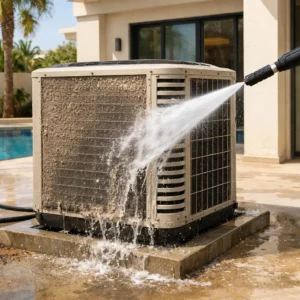
In hot climates, this pattern often appears when condenser coils are dirty or airflow is blocked.
High Suction Pressure + Low Discharge Pressure
- Compressor inefficiency
- Worn valves
- Internal compressor damage
This scenario often indicates mechanical failure rather than a refrigerant issue.
Why Pressure Alone Is Never Enough
A common mistake is using r410 gas pressure as the only diagnostic tool. Pressure must always be evaluated with:
- Line temperature measurements
- Indoor and outdoor airflow checks
- Electrical performance data
Without this context, pressure readings can be misleading and result in unnecessary gas refills or component replacement.
Common Mistakes When Checking R410 Gas Pressure
- Measuring pressure without stabilizing the system
- Ignoring ambient temperature conditions
- Using incorrect or low-rated gauges
- Adding refrigerant based on pressure alone
These mistakes often lead to overcharging, compressor damage, and repeated service calls.
Best Practices for Reliable Pressure Diagnosis
- Allow the system to run long enough to stabilize
- Measure both pressure and temperature simultaneously
- Refer to manufacturer specifications whenever possible
- Prioritize airflow and cleanliness checks before adjusting charge
In many cases, correcting airflow or cleaning coils resolves abnormal pressure without touching refrigerant levels.
When Pressure Issues Should Be Handled by Professionals
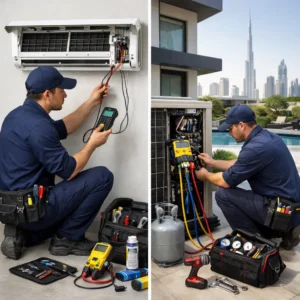
While basic pressure awareness is useful, working directly with R410A under pressure carries risk. Improper handling can lead to injury, environmental harm, or severe system damage.
Professional technicians use calibrated tools, follow safety procedures, and interpret pressure data within the full system context. This reduces the risk of misdiagnosis and protects both the equipment and the people involved.
Conclusion
Understanding r410 gas pressure is essential for operating, maintaining, and diagnosing modern AC systems. Normal pressure ranges provide a baseline, but real insight comes from understanding how pressure changes with temperature, airflow, and system load. Because R410A operates at much higher pressures than older refrigerants, safety, proper equipment, and correct interpretation are non-negotiable.
Pressure readings are most powerful when used as part of a broader diagnostic approach that includes temperature measurements, airflow evaluation, and system history. When interpreted correctly, they help identify undercharge, overcharge, airflow problems, and component faults before serious damage occurs. In high-demand climates, this knowledge protects comfort, efficiency, and long-term system reliability.