




R32 gas pressure is one of the most misunderstood topics in modern air conditioning systems, even among experienced users. Many people look at pressure readings without fully understanding what they mean, how they change with temperature, or how they should be interpreted in real operating conditions. This article explains R32 gas pressure in a practical and structured way—covering normal pressure ranges, how pressure relates to temperature, how R32 compares with R410A, how pressure readings can help diagnose problems, and what safety considerations must never be ignored when working with R32.
Table of Contents
ToggleUnderstanding What R32 Gas Pressure Really Means
In any vapor-compression air conditioning system, refrigerant pressure is not a fixed number. It is a dynamic value that changes continuously based on operating conditions. When people talk about “R32 gas pressure,” they are usually referring to one of three different pressure states:
- Suction pressure – the low-side pressure at the compressor inlet
- Discharge pressure – the high-side pressure at the compressor outlet
- Standing pressure – the equalized pressure when the system is off
Each of these pressures tells a different story about how the system is operating. Looking at only one value without context often leads to wrong conclusions, unnecessary gas charging, or even system damage.
R32 is a single-component refrigerant, unlike blended refrigerants. This makes its pressure-temperature relationship more predictable, but it also means technicians must be accurate when interpreting readings.
Typical Operating Pressure Ranges for R32
R32 pressure values vary with ambient temperature, indoor load, airflow, and system design. The numbers below should always be treated as reference ranges, not fixed targets.
Typical R32 Suction Pressure
Suction pressure reflects the evaporating temperature of the refrigerant. In comfort cooling applications, normal R32 suction pressure often falls within these approximate ranges:
- Cooling mode, normal load: 110–150 psi
- Light load or low ambient: 90–110 psi
- Heavy load or high ambient: 150–170 psi
Lower suction pressure generally means lower evaporating temperature, which can be caused by restricted airflow, low refrigerant charge, or cold ambient conditions. Higher suction pressure can indicate overcharge, excessive load, or insufficient heat removal in the evaporator.
Typical R32 Discharge Pressure
Discharge pressure represents the condensing temperature and how effectively heat is rejected at the condenser. Typical R32 discharge pressure ranges are:
- Moderate outdoor temperature: 350–420 psi
- High ambient temperature: 420–500+ psi
- Poor condenser airflow or dirty coil: often above normal range
High discharge pressure increases compressor stress, raises energy consumption, and can shorten system life. That is why discharge pressure should always be evaluated together with condenser condition and airflow.
Standing Pressure for R32
Standing pressure is measured when the system is off and pressures have equalized. This pressure depends almost entirely on ambient temperature.
For example:
- At around 25°C, standing pressure may be roughly 210–230 psi
- At around 35°C, standing pressure may rise to 260–280 psi
Standing pressure is useful for confirming refrigerant type and approximate system condition, but it cannot diagnose operating problems by itself.
How R32 Pressure Relates to Temperature (PT Chart Concept)
Pressure and temperature are directly linked in refrigerants. This relationship is explained using a pressure-temperature (PT) chart.
For R32, every pressure corresponds to a specific saturation temperature. This allows technicians to:
- Estimate evaporator temperature from suction pressure
- Estimate condensing temperature from discharge pressure
- Identify abnormal heat transfer conditions
For example, if R32 suction pressure is about 130 psi, the saturation temperature is roughly 5–7°C. If airflow across the evaporator is correct, the actual air temperature drop should align with this value. If not, something is wrong.
Likewise, if discharge pressure corresponds to a condensing temperature much higher than outdoor air temperature plus expected temperature difference, the condenser may be dirty or airflow restricted.
Understanding this relationship is far more accurate than relying on “normal pressure numbers” alone.
R32 vs R410A Pressure Comparison
R32 is often compared with R410A because R410A systems are being replaced or redesigned using R32. While both refrigerants operate at relatively high pressure, they are not identical.
Pressure Level Comparison
- R32 generally operates at slightly lower pressure than R410A under similar conditions
- R410A discharge pressures are typically higher for the same cooling capacity
This difference means R32 systems may experience slightly reduced compressor stress when designed correctly.
Charge Amount and Efficiency
R32 requires approximately 20–30% less refrigerant charge than R410A for the same system capacity. This is because R32 has higher volumetric capacity and better heat transfer characteristics.
Lower charge quantity reduces environmental impact and can improve system efficiency when properly engineered.
Safety Classification Differences
R410A is classified as A1 (non-flammable), while R32 is classified as A2L (mildly flammable).
This does not mean R32 is unsafe, but it does mean:
- Ventilation is more critical during servicing
- Leak management procedures are stricter
- Charging practices must follow safety standards
Using R32 Pressure Readings for Troubleshooting
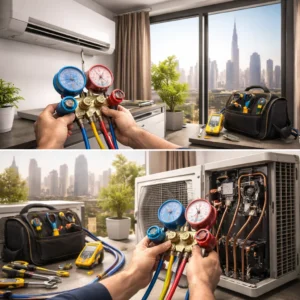
Pressure readings are one of the most powerful diagnostic tools when used correctly. However, pressure must always be interpreted together with temperature, airflow, and system behavior.
Low Suction Pressure Scenarios
Low suction pressure may indicate:
- Low refrigerant charge due to leak
- Restricted airflow at the evaporator
- Dirty filter or blocked return air
- Expansion device restriction
If suction pressure is low and superheat is high, refrigerant shortage or airflow restriction is likely. Simply adding gas without identifying the cause often leads to repeat problems.
High Suction Pressure Scenarios
High suction pressure may indicate:
- Overcharged system
- Excessive indoor heat load
- Malfunctioning expansion valve
High suction pressure combined with poor cooling performance often points to incorrect charge or control issues rather than a lack of refrigerant.
High Discharge Pressure Scenarios
High discharge pressure is one of the most dangerous conditions for compressors. Common causes include:
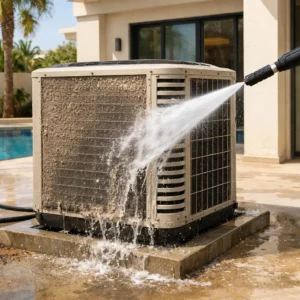
- Dirty condenser coil
- Restricted condenser airflow
- Overcharge
- High ambient temperature without adequate heat rejection
In many cases, cleaning the condenser or improving airflow reduces discharge pressure more effectively than adjusting refrigerant charge.
Low Discharge Pressure Scenarios
Low discharge pressure can indicate:
- Low refrigerant charge
- Low outdoor temperature
- Compressor inefficiency
Again, context is critical. A cold outdoor environment naturally lowers discharge pressure.
Why Pressure Alone Is Not Enough
One of the biggest mistakes in AC servicing is diagnosing systems using pressure readings alone. Pressure must always be evaluated together with:
- Air temperature entering and leaving the evaporator
- Superheat and subcooling values
- Airflow condition
- System load
An R32 system can show “normal” pressure while still performing poorly if airflow is restricted or coils are contaminated.
Safety and Handling Considerations for R32
R32 requires a higher level of discipline during handling compared to older refrigerants.
Ventilation and Work Area Safety
Because R32 is mildly flammable, servicing should always be done in well-ventilated areas. Accumulation of refrigerant in confined spaces must be avoided.
Charging and Recovery Practices
- Use equipment rated for A2L refrigerants
- Avoid open flames or ignition sources nearby
- Charge by weight using manufacturer specifications
Improper charging not only affects performance but also increases safety risks.
Leak Detection Importance
With R32, leak detection is critical. Any loss of refrigerant changes pressure behavior and system efficiency.
Persistent pressure imbalance often indicates a leak that must be repaired before recharging.
Common Misunderstandings About R32 Gas Pressure
- High pressure does not always mean overcharge
- Low pressure does not always mean lack of refrigerant
- Standing pressure cannot diagnose running issues
- Ambient temperature heavily influences readings
Understanding these points helps prevent unnecessary adjustments that cause more harm than good.
When R32 Pressure Issues Should Be Handled Professionally
While basic observation is useful, interpreting R32 pressure accurately requires training, proper instruments, and experience. Incorrect handling can damage compressors, increase energy use, and create safety risks.
Professional AC technicians evaluate pressure as part of a complete system assessment, ensuring that airflow, cleanliness, charge level, and safety requirements are all addressed together.
Conclusion
Understanding R32 gas pressure goes far beyond memorizing pressure numbers. Suction, discharge, and standing pressures must always be interpreted in context with temperature, airflow, and system load. R32 operates at high pressure but slightly lower than R410A, requires less refrigerant charge, and offers improved efficiency when handled correctly.
Using pressure readings properly can help identify leaks, overcharge, airflow issues, and dirty coils—but pressure alone is never enough. Safe handling, accurate diagnosis, and respect for R32’s A2L classification are essential. When pressure behavior seems unclear or abnormal, professional assessment is the safest way to protect both system performance and long-term reliability.