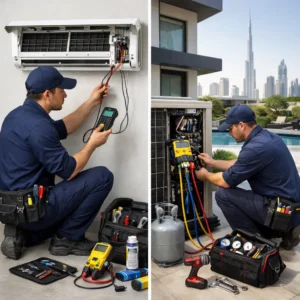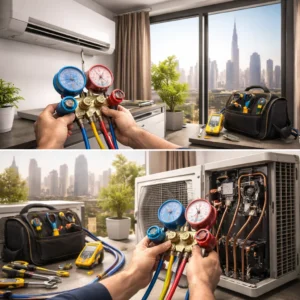





R22 gas pressure is one of the most misunderstood topics in air conditioning diagnostics. Many people look at a pressure gauge, see a low or high number, and immediately assume the refrigerant level is wrong. In reality, pressure alone never tells the full story. R22 pressure must always be interpreted together with temperature, system condition, airflow, and operating state. This article explains R22 gas pressure in a practical, technician-aware but non-confusing way, so you can understand what “normal” really means, why pressure changes, and why low pressure almost always indicates a leak rather than normal refrigerant loss.
Table of Contents
ToggleUnderstanding R22 as a Refrigerant
R22 (chlorodifluoromethane) is a hydrochlorofluorocarbon (HCFC) refrigerant that has been widely used in older split AC, window AC, and some packaged systems. R22 operates at moderate pressures compared to newer refrigerants like R410A, which is one reason many technicians historically found it easier to service.
However, R22 systems are now considered legacy systems. While many are still operating, R22 production and import are restricted or phased out in many regions due to environmental regulations. This makes understanding R22 pressure behavior even more important, because improper handling can lead to expensive mistakes.
Before discussing numbers, it is critical to understand one rule that applies to all refrigerants:
Pressure by itself does not indicate charge level.
Pressure is always a result of temperature, refrigerant state, and system conditions.
Typical Low-Side (Suction) Pressure for R22
The low-side pressure, also called suction pressure, is measured on the evaporator side of the system. This pressure reflects how the refrigerant is evaporating and absorbing heat.
Under normal operating conditions, a typical R22 system will show:
- Low-side pressure range: approximately 60–80 psi
This range assumes:
- Normal indoor load
- Proper airflow across the evaporator coil
- Outdoor ambient temperature around 30–40°C
- System running steadily, not cycling
Lower than normal suction pressure does not automatically mean “low gas.” It may indicate:
- Restricted airflow (dirty filter, blocked coil)
- Frozen evaporator
- Metering device restriction
- Actual refrigerant leak
This is why suction pressure must always be evaluated together with temperature and system behavior.
Typical High-Side (Discharge) Pressure for R22
The high-side pressure, also called discharge or head pressure, is measured on the condenser side. It reflects how efficiently the system is rejecting heat.
Under normal operating conditions, R22 systems typically show:
- High-side pressure range: approximately 200–260 psi
This range varies significantly based on outdoor temperature. Higher ambient temperatures raise condensing pressure, even if the refrigerant charge is correct.
Abnormally high discharge pressure may be caused by:
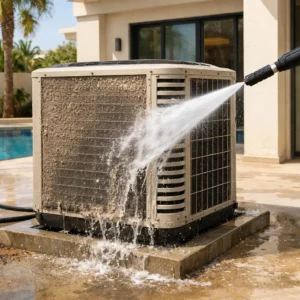
- Dirty or blocked condenser coil
- Poor condenser airflow
- Overcharged refrigerant
- Non-condensable gases in the system
Abnormally low discharge pressure can indicate:
- Low refrigerant due to leakage
- Compressor inefficiency
- Very low outdoor temperature
Why Pressure Cannot Be Judged Without Temperature
This is the most critical concept in understanding R22 gas pressure.
Refrigerant pressure is directly linked to temperature through the pressure–temperature (PT) relationship. Every refrigerant has a known saturation pressure at a given temperature.
For example:
- At approximately 5°C evaporating temperature, R22 saturation pressure is about 68 psi
- At approximately 40°C condensing temperature, R22 saturation pressure is about 235 psi
This means:
- Pressure changes even if refrigerant quantity stays the same
- Ambient temperature directly affects readings
- Comparing pressure numbers without temperature is misleading
This is why professional diagnostics always involve temperature measurement along with pressure gauges.
Using PT Charts to Interpret R22 Pressure
A pressure–temperature (PT) chart allows you to convert gauge pressure into saturation temperature. This is essential for understanding system performance.
Basic example using R22:
- Gauge reads 70 psi on the suction side
- PT chart shows this equals about 5–6°C saturation temperature
You then compare this saturation temperature with the actual pipe temperature to calculate superheat.
Without a PT reference, pressure numbers alone are meaningless.
Standing Pressure of R22 When the System Is Off
Standing pressure is the equalized pressure in the system when the compressor is not running. This pressure depends almost entirely on ambient temperature.
Typical standing pressure for R22:
- At around 25°C ambient temperature: 150–160 psi
- At around 30°C: 170–180 psi
Standing pressure is useful for basic checks:
- If standing pressure is much lower than expected, it strongly suggests refrigerant loss due to leakage
- If standing pressure is near zero, the system is likely empty
Refrigerant does not get “used up.” If pressure drops over time, the refrigerant escaped somewhere.
Why Low R22 Pressure Almost Always Means a Leak
One of the most persistent myths in HVAC is that refrigerant “runs out” naturally. This is false.
R22 is contained in a sealed system. Under normal conditions:
- Refrigerant does not degrade
- Refrigerant does not evaporate into nothing
- Charge level remains constant for years
If suction and discharge pressures are consistently low, the most common cause is a leak.
Adding more R22 without finding the leak:
- Temporarily restores cooling
- Does not fix the root cause
- Leads to repeated failures and higher cost
Because R22 is expensive and regulated, topping up without leak repair is both financially and environmentally irresponsible.
Basic Diagnostic Concept: Superheat in R22 Systems
Superheat measures how much the refrigerant vapor is heated above its saturation temperature after boiling.
Basic steps:
- Measure suction pressure
- Convert pressure to saturation temperature using PT chart
- Measure actual suction line temperature
- Subtract saturation temperature from actual temperature
Typical target superheat for R22 systems:
- 8–12°C for fixed orifice systems
- Lower values for TXV-controlled systems
Low superheat may indicate:
- Overfeeding refrigerant
- Floodback risk
High superheat may indicate:
- Low refrigerant charge
- Restricted metering device
- Airflow problems
Basic Diagnostic Concept: Subcooling in R22 Systems
Subcooling measures how much liquid refrigerant is cooled below its saturation temperature in the condenser.
Basic steps:
- Measure discharge pressure
- Convert to saturation temperature
- Measure liquid line temperature
- Subtract liquid line temperature from saturation temperature
Typical R22 subcooling values:
- 8–15°C for systems with TXV
Low subcooling often indicates:
- Low refrigerant charge
- Leak in the system
Excessive subcooling may indicate:
- Overcharge
- Restricted condenser airflow
Common Pressure-Related Problems in R22 Systems
Low Suction Pressure and Ice Formation
Low suction pressure often leads to evaporator temperatures below freezing.
Common causes:
- Dirty air filter
- Blocked evaporator coil
- Low refrigerant due to leak
Ice formation further restricts airflow, making pressure drop even more.
High Head Pressure Due to Overcharge
Adding R22 without proper measurement can raise head pressure dangerously.
Consequences:
- Compressor overheating
- Higher electricity consumption
- Premature component failure
Normal Pressure but Poor Cooling
This confuses many people. Pressure may appear “normal,” but cooling is still weak.
Possible causes:
- Dirty coils
- Airflow imbalance
- Humidity load mismatch
This again shows why pressure alone is not a diagnostic tool.
R22 Phase-Out Regulations and Practical Implications
R22 is being phased out globally due to ozone depletion concerns. Production and import are restricted in many countries.
Practical implications:
- R22 is increasingly expensive
- Availability is limited
- Improper use carries regulatory risk
Repeated topping up of leaking R22 systems is no longer sustainable. In many cases, leak repair or system replacement becomes the more responsible option.
Why Proper Diagnosis Matters More Than Pressure Numbers
Looking at R22 gas pressure without understanding system context leads to wrong decisions. Pressure must be evaluated alongside:
- Temperature
- Airflow
- Load conditions
- Superheat and subcooling
This is why professional inspection focuses on system behavior, not just gauge readings.
Conclusion
R22 gas pressure is not a simple number that tells you whether an AC system is healthy or not. Normal low-side and high-side pressure ranges only make sense when combined with temperature measurements and operating conditions. Standing pressure helps identify leaks when the system is off, while superheat and subcooling provide deeper insight into refrigerant behavior inside the system.
Low pressure in an R22 system almost always indicates a leak, not normal refrigerant loss. Topping up without finding the leak leads to repeated failures, higher cost, and environmental harm—especially with R22 now regulated and expensive. Understanding the pressure–temperature relationship and using PT references correctly is the foundation of accurate diagnosis. In modern HVAC practice, proper diagnosis matters far more than chasing pressure numbers.