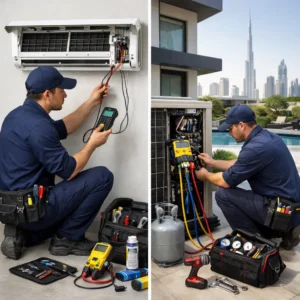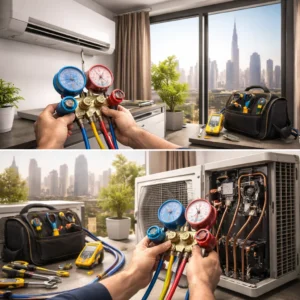





Searching for freon leak test usually means your AC is not cooling properly, needs frequent gas refills, or shows warning signs that something is wrong inside the system. In hot climates like the UAE, refrigerant leaks are not just a performance issue. They affect energy efficiency, indoor comfort, repair costs, and environmental safety. This guide explains, in practical terms, how freon leak testing works, what you can check yourself, when professional testing is necessary, how reliable each method is, and why low freon is never “normal” consumption.
Table of Contents
ToggleWhat Is a Freon Leak and Why It Matters
Freon is a general term commonly used to describe refrigerants used in air conditioning systems, such as R22, R410A, or R32. These refrigerants circulate inside a sealed system. Under normal conditions, refrigerant does not get “used up.” If the level is low, it means there is a leak somewhere.
A freon leak matters for several reasons:
- Cooling performance drops because the system cannot absorb and release heat efficiently.
- The compressor works harder, increasing electricity consumption.
- Repeated refilling without fixing the leak leads to higher long-term costs.
- Refrigerant release harms the environment and may violate regulations.
Understanding how to test for leaks helps you avoid temporary fixes and repeated expenses.
Common Visual Signs of a Possible Freon Leak Before Testing
Before performing any formal freon leak test, many systems show visible or behavioral signs that suggest a leak may exist.
Common indicators include:
- Weak or warm airflow: The AC runs but does not cool effectively.
- Frequent need for gas refill: Cooling improves briefly after refill, then declines again.
- Ice buildup on coils or refrigerant lines: Low pressure can cause freezing.
- Hissing or bubbling sounds: Escaping gas may create faint noise.
- Oil stains on pipes or joints: Refrigerant oil often leaks together with gas.
These signs do not pinpoint the exact leak location, but they strongly suggest that a freon leak test is needed.
Soap Bubble Test (Basic DIY Method)
The soap bubble test is one of the simplest and most commonly used DIY methods for detecting refrigerant leaks.
How the Soap Bubble Test Works
A mixture of soap and water is applied to suspected leak points such as pipe joints, flare connections, or service valves. If gas is leaking, bubbles will form where the gas escapes.
Where It Works Best
- Visible joints and fittings
- Accessible outdoor unit connections
- Areas with slow, steady leaks
Limitations
- Cannot detect very small or internal leaks
- Not effective on hidden piping or inside coils
- Results depend on system pressure at the time of testing
Soap bubble testing is helpful as an initial check but should not be considered a complete freon leak test.
Electronic Refrigerant Leak Detectors
Electronic leak detectors are handheld devices designed to sense the presence of refrigerant gas in the air.
How Electronic Detectors Work
The detector’s sensor reacts to refrigerant molecules. When the device passes near a leak, it triggers an alarm or visual signal.
Advantages
- Can detect smaller leaks than soap bubbles
- Useful around complex piping
- Relatively fast to use
Limitations
- False positives from cleaning chemicals or other gases
- Requires proper calibration
- Less effective in windy or open environments
Electronic detectors are widely used by professionals during AC repair inspections. They are more reliable than DIY methods but still depend on technician experience.
UV Dye Leak Testing
UV dye testing is a method where a fluorescent dye is injected into the refrigerant system.
How UV Dye Testing Works
The dye circulates with the refrigerant. Over time, it escapes at the leak point. A UV light is then used to inspect components, revealing bright dye traces where leaks exist.
Strengths
- Excellent for identifying exact leak locations
- Works well for slow or intermittent leaks
- Provides visual confirmation
Limitations
- Requires system operation time
- Not suitable for emergency diagnosis
- Needs professional handling to avoid contamination
UV dye testing is commonly used in professional freon leak test procedures when leaks are difficult to locate.
Ultrasonic Leak Detection
Ultrasonic detection identifies high-frequency sound produced by gas escaping from pressurized systems.
How It Works
Specialized sensors detect ultrasonic noise caused by refrigerant leakage, even when the leak is not audible to humans.
Advantages
- Detects very small leaks
- Works without adding chemicals
- Effective in noisy environments
Limitations
- Requires specialized equipment
- Higher cost than basic methods
- Best handled by trained technicians
This method is typically used in professional diagnostics rather than DIY inspections.
Nitrogen Pressure Testing (Professional Standard)
Nitrogen pressure testing is considered one of the most reliable professional freon leak test methods.
How Nitrogen Testing Works
The refrigerant is safely recovered, and the system is pressurized with dry nitrogen. Pressure gauges monitor any drop, indicating a leak.
Why Nitrogen Is Used
- Non-flammable and safe
- Does not contaminate the system
- Allows precise pressure monitoring
Limitations
- Requires refrigerant recovery equipment
- Time-consuming
- Professional-only method
Nitrogen pressure testing is often combined with electronic or soap testing to locate the exact leak point.
DIY-Friendly Tests vs Professional Diagnostic Methods
Not all freon leak tests are suitable for homeowners or tenants.
| Method | DIY Friendly | Reliability |
|---|---|---|
| Soap Bubble Test | Yes | Low to Moderate |
| Electronic Detector | Limited | Moderate |
| UV Dye | No | High |
| Ultrasonic Detection | No | High |
| Nitrogen Pressure Test | No | Very High |
DIY methods can help confirm suspicion, but professional testing is required for accurate diagnosis and proper repair.
Why Low Freon Always Means a Leak
One common misconception is that refrigerant naturally decreases over time. In reality, AC systems are closed loops.
If freon is low, it means:
- A joint has loosened
- A pipe has corroded
- A coil has developed micro-cracks
Refilling without leak repair only masks the problem. This is why professional AC gas refill and leak repair focuses on testing and sealing leaks first.
Typical Cost of Professional Freon Leak Testing
The cost of professional freon leak testing depends on system size, method used, and accessibility.
Typical ranges include:
- Basic electronic leak detection: lower cost
- UV dye testing: moderate cost due to materials and time
- Nitrogen pressure testing: higher cost due to equipment and labor
While professional testing costs more upfront, it usually saves money by preventing repeated refills and compressor damage.
Legal and Environmental Considerations
Refrigerants are regulated substances due to their environmental impact.
Important considerations include:
- Intentional venting of refrigerant is not allowed
- Leaks must be repaired before refilling
- Certified technicians should handle refrigerants
Professional AC repair services follow proper recovery and disposal procedures to comply with environmental regulations.
When Freon Leak Testing Should Be Handled Professionally
Freon leaks rarely resolve themselves. If ignored, they reduce cooling efficiency, increase electricity bills, and can cause compressor failure. Bio On Air handles freon leak testing as part of a proper AC repair process, using safe diagnostic methods and clear communication. Acting early helps avoid higher costs and environmental harm. You can use the WhatsApp or Call button at the top right of this page to discuss suspected refrigerant leaks with our team.
Conclusion
A freon leak test is not just about finding escaping gas. It is about protecting system performance, energy efficiency, and long-term reliability. Visual signs can indicate a problem, but accurate testing requires the right tools and methods.
DIY checks like soap bubbles may help confirm suspicion, but professional diagnostic methods such as electronic detection, UV dye testing, ultrasonic detection, and nitrogen pressure testing provide reliable results. Understanding that low freon always indicates a leak helps prevent repeated refills and unnecessary damage. When handled correctly, leak testing becomes a preventive step that protects both your comfort and the environment.