




Searching for an ac technician tools list usually means you are either starting your HVAC career, upgrading your skill level, or trying to work more efficiently and safely in the field. Many technicians struggle not because they lack knowledge, but because they use the wrong tools at the wrong stage. This guide is designed as a structured, career-stage reference that explains what tools you actually need, what each category is used for, what problems they help prevent, and how to invest wisely without overspending or compromising safety.
Table of Contents
ToggleHow to Read This AC Technician Tools List
This is not a simple shopping list. Instead, it is a structured flow that follows how AC technicians actually grow in the field. Tools are grouped by career stage and function, not by brand. For every category, we explain:
- What the tools are used for in real work scenarios
- What mistakes or rework they help prevent
- How to think about quality versus price using investment tiers
- When it makes sense to upgrade
Throughout this guide, when cost is mentioned, you should tell the price based on your local market and supplier instead of relying on fixed numbers. This approach helps you make decisions that match your budget, region, and workload.
Career Stage 1: Rookie AC Technician Starter Hand Tools
At the rookie level, the goal is not speed or advanced diagnostics. The goal is to work safely, understand system layout, and perform basic service tasks without damaging equipment.
Essential Hand Tools for Beginners
These tools are used daily for access, adjustment, and basic servicing:
- Screwdrivers (flat and cross types) for panel access and terminal adjustments
- Adjustable wrench for fittings and brackets
- Spanner set for common AC fasteners
- Pliers and needle-nose pliers for gripping and bending
- Hex keys for indoor unit and motor mounts
- Utility knife for insulation and packaging removal
What these tools help prevent: stripped screws, damaged panels, loose fittings, and unnecessary call-backs due to poor reassembly.
Quality vs Price at Rookie Level
At this stage, durability matters more than precision. Budget-friendly tools are acceptable as long as they are solid, well-fitted, and safe to use. Avoid extremely cheap tools that bend easily or have poor insulation, as they can cause injury or damage equipment.
If you are training or assisting senior technicians, start with reliable basic tools and upgrade only when your workload becomes consistent.
Career Stage 2: Core Diagnostic Instruments
Once you move beyond basic servicing, diagnostics become critical. Incorrect diagnosis is one of the biggest causes of rework, wasted time, and customer dissatisfaction.
Electrical Diagnostic Tools
- Multimeter for voltage, resistance, and continuity checks
- Clamp meter for current measurement without disconnecting wires
- Non-contact voltage tester for quick safety checks
What these tools are used for: identifying electrical faults, verifying power supply, checking sensors, and confirming control board behavior.
What they help prevent: replacing the wrong component, unsafe electrical handling, and repeated site visits.
Thermal and Airflow Measurement Tools
- Thermometer or temperature probe for inlet and outlet comparison
- Infrared thermometer for quick surface temperature checks
- Anemometer for airflow measurement
These tools help you confirm whether cooling performance issues are caused by airflow restriction, heat exchange problems, or refrigerant imbalance.
Analog vs Digital Diagnostics
Analog tools are generally more rugged and easier to maintain. They are less sensitive to moisture and rough handling but require more skill to interpret.
Digital tools provide faster readings, higher accuracy, and clearer documentation. However, they require calibration and careful storage.
For most technicians, a mixed setup works best: analog tools for durability, digital tools for precision.
Career Stage 3: Refrigerant Handling and Service Equipment
Refrigerant handling is a legal and technical responsibility. Mistakes here can cause system damage, safety risks, and compliance issues.
Core Refrigerant Tools
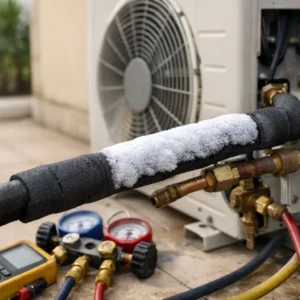
- Manifold gauge set for pressure measurement
- Vacuum pump for moisture removal
- Refrigerant recovery unit
- Charging scale
What these tools are used for: accurate charging, leak testing, evacuation, and system stabilization.
What they help prevent: compressor damage, moisture contamination, inefficient cooling, and repeat gas refill complaints.
Investment Tier Guidance
This is where quality matters more. Entry-level equipment may work initially, but professional-grade tools last longer, maintain accuracy, and reduce rework. Instead of chasing the lowest cost, compare durability, serviceability, and calibration stability, then tell the price based on your supplier.
Career Stage 4: Heavy Equipment and Installation Tools
For technicians involved in installation, replacement, or major repair, heavy equipment becomes essential.
Mechanical and Installation Tools
- Drill and impact driver
- Core drilling tools for piping routes
- Pipe bender and flaring tools
- Tube cutter and deburring tools
- Lifting aids and mounting supports
What these tools help prevent: refrigerant leaks from poor flaring, vibration issues, misalignment, and structural damage.
These tools require proper training. Poor technique causes more problems than having no tool at all.
Career Stage 5: Professional Upgrade and Efficiency Tools
Experienced technicians focus on speed, accuracy, and documentation. Professional upgrade tools support these goals.
Advanced Diagnostic and Workflow Tools
- Digital manifold systems with data logging
- Wireless temperature probes
- Leak detection instruments
- Inspection cameras for drains and ducts
What these tools improve: diagnostic confidence, reporting clarity, and first-visit fix rates.
These tools are investments. They do not replace skill, but they amplify it.
Safety and Compliance: Mandatory Equipment for AC Technicians
Safety tools are not optional. They protect you, the client, and the system.
Personal Protective Equipment (PPE)
- Insulated gloves
- Safety goggles
- Respiratory protection when required
- Protective footwear
Electrical and Refrigerant Safety Tools
- Lockout and tagout devices
- Insulated mats
- Gas detection and ventilation tools
Failure to use proper safety equipment can result in injury, legal responsibility, and loss of professional credibility.
Tool Maintenance: Calibration, Cleaning, and Storage
Even the best tools fail if poorly maintained.
Calibration
Diagnostic tools must be calibrated regularly to maintain accuracy. Incorrect readings lead to wrong decisions.
Cleaning
Dust, oil, and moisture shorten tool lifespan. Clean tools after use, especially probes and gauges.
Storage
Use protective cases and dry storage. Avoid leaving tools exposed in vehicles during extreme heat.
Analog vs Digital Tools: Technical Comparison
| Aspect | Analog Tools | Digital Tools |
|---|---|---|
| Accuracy | Good, depends on user skill | High, consistent |
| Speed | Slower interpretation | Fast readings |
| Durability | Very robust | Moderate, needs care |
| Maintenance | Low | Requires calibration |
| Workflow Efficiency | Manual documentation | Supports digital reporting |
Usability Concept: Interactive Checklist and Printable Tool List
A practical way to manage your tools is to maintain a checklist based on job type:
- Service visit checklist
- Diagnostic checklist
- Installation checklist
- Emergency call checklist
This can be turned into a printable list or a mobile checklist to reduce forgotten tools and wasted trips.
Why the Right AC Technician Tools Matter in Real Work
Using the right tools at the right stage reduces rework, protects system components, improves safety, and builds trust with clients. Many service failures are not due to lack of knowledge, but due to incorrect or inadequate tools.
Conclusion
An effective ac technician tools list is not about owning everything. It is about matching tools to your career stage, understanding what each tool is used for, and investing wisely over time. Start with solid hand tools, add diagnostic instruments as your responsibility grows, and upgrade to professional-grade equipment when accuracy and efficiency matter most.
Always balance quality and price by comparing durability, accuracy, and long-term value rather than chasing the lowest cost. Maintain your tools carefully, follow safety requirements, and use structured checklists to stay consistent. When tools support your skill instead of limiting it, your work becomes safer, faster, and more reliable.