




If you are searching how ac remove humidity in Dubai, you are likely dealing with a common issue—your AC cools the air, but your home still feels damp, sticky, or uncomfortable. In the UAE, humidity control is just as important as cooling. This guide explains how to fix it step by step.
Table of Contents
ToggleQuick AC Settings That Help Remove Humidity
Before assuming something is wrong with your system, start with basic adjustments. Many humidity issues come from incorrect AC settings rather than major faults.
Use Dry Mode vs Cool Mode
Most modern AC systems include a “Dry Mode.” This mode is specifically designed to remove moisture from the air rather than aggressively cooling the room.
- Dry Mode: Focuses on humidity removal, slower cooling
- Cool Mode: Focuses on temperature reduction
If your space feels cold but still humid, switching to Dry Mode can improve comfort significantly.
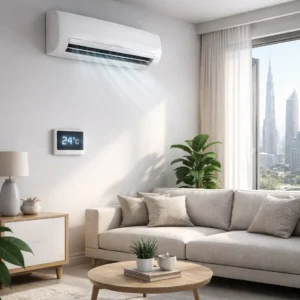
Set Temperature Around 24°C
Setting your AC too low (like 18–20°C) may seem helpful, but it can actually reduce dehumidification efficiency. At very low temperatures, the AC cycles too quickly and doesn’t stay on long enough to remove moisture.
Recommended setting:
- 24°C for balanced cooling and humidity control
Switch Fan Mode to Auto
When the fan is set to “ON,” it runs continuously—even when the compressor is off. This can reintroduce moisture into the room.
Using “AUTO” allows the system to:
- Run only when cooling is active
- Improve moisture removal efficiency
Why Your AC Cools but Does Not Remove Humidity
In Dubai apartments, this is one of the most common complaints. The room feels cold, but the air feels heavy or sticky. This usually means the AC is not properly removing moisture.
Oversized AC Unit
An oversized AC cools the room too quickly and shuts off before it can remove enough humidity.
This results in:
- Cold but humid air
- Short cycling
- Poor comfort
Dirty Evaporator Coil
The evaporator coil is where moisture is removed. If it is covered with dust or dirt, it cannot absorb humidity effectively.
Signs include:
- Weak dehumidification
- Reduced cooling performance
Frozen Coil
If airflow is restricted or refrigerant levels are incorrect, the coil may freeze. When frozen, it cannot remove moisture properly.
Airflow Problems
Blocked filters, dirty ducts, or closed vents can reduce airflow, preventing proper humidity removal.
Airflow is critical because:
- Air must pass through the coil for moisture removal
- Restricted airflow reduces efficiency
Essential Maintenance Steps to Improve Dehumidification
Clean or Replace AC Filters
Dirty filters are one of the most common causes of poor humidity control.
- Clean washable filters every 2–4 weeks
- Replace disposable filters regularly
Clean Condensate Drain Line
The condensate drain removes moisture collected by the AC. If it is blocked, water cannot drain properly.
This can lead to:
- High indoor humidity
- Water leakage
- Mold growth
Seal Air Gaps in Windows and Doors
In Dubai apartments, warm humid air often enters through small gaps in balcony doors or windows.
Check for:
- Loose seals
- Gaps around frames
- Air leaks near sliding doors
Sealing these gaps reduces humidity load on your AC.
Ideal Indoor Humidity Levels in Dubai
Maintaining proper humidity is important for comfort and health.
| Humidity Level | Condition |
|---|---|
| 30% – 50% | Ideal comfort range |
| 50% – 60% | Acceptable but slightly humid |
| Above 60% | High humidity (risk of mold and discomfort) |
In Dubai, maintaining humidity below 55% is usually the goal.
Daily Habits That Increase Indoor Humidity
Sometimes the problem is not the AC—it’s daily habits that introduce moisture into your home.
Opening Windows Frequently
Outdoor air in Dubai is often humid, especially in coastal areas. Opening windows allows moisture to enter.
Drying Laundry Indoors
Wet clothes release significant moisture into the air.
Long Hot Showers Without Ventilation
Bathrooms can quickly fill with steam, which spreads to other rooms.
Reducing these habits can improve humidity control.
When You Need a Dehumidifier in Dubai
In some cases, your AC alone may not be enough to control humidity.
You may need a dehumidifier if:
- Your apartment stays humid despite AC use
- You live near coastal areas
- There is persistent moisture or mold smell
A dehumidifier works alongside your AC to remove excess moisture more effectively.
When Professional AC Service Is Required
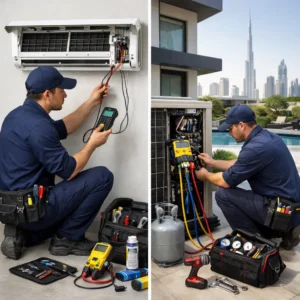
If basic adjustments and maintenance do not solve the issue, professional servicing may be necessary.
This may involve:
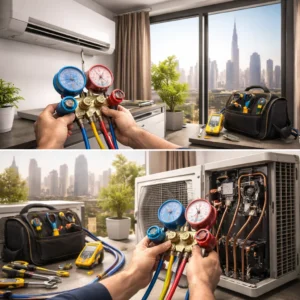
- Checking refrigerant levels
- Inspecting evaporator coils
- Cleaning internal components
- Evaluating airflow and duct condition
In many cases, issues related to humidity are linked to deeper system problems that require proper inspection. A structured AC maintenance approach helps ensure your system operates efficiently and maintains balanced humidity levels.
How AC Actually Removes Humidity
Understanding how your AC works helps explain why problems occur.
When warm air passes over the evaporator coil:
- Moisture condenses into water
- Water drains through the condensate line
- Dry air is circulated back into the room
If any part of this process is disrupted, humidity removal becomes ineffective.
Common Signs Your AC Is Not Removing Humidity Properly
- Sticky or damp feeling indoors
- Condensation on windows
- Musty smell
- Mold spots on walls or ceilings
These signs indicate that moisture is not being properly controlled.
Long-Term Solutions for Humidity Control
Fixing humidity is not just about short-term adjustments—it requires a long-term approach.
- Regular AC maintenance
- Periodic duct cleaning
- Proper insulation and sealing
- Balanced system sizing
These steps ensure consistent comfort and air quality.
Cost Consideration for Fixing Humidity Issues
The cost of fixing humidity issues depends on the cause:
- Filter cleaning: low cost
- Drain cleaning: low to moderate cost
- Deep AC cleaning: moderate cost
- Refrigerant adjustment: moderate to higher cost
Addressing issues early is always more affordable than waiting for system failure.
If your AC is not removing humidity properly, it is important not to ignore it. Excess moisture can lead to mold growth, poor air quality, higher electricity consumption, and long-term damage to your AC system. In Dubai’s climate, humidity problems can worsen quickly if left untreated. Taking action early helps protect both your comfort and your system. If you are unsure about the condition of your AC, you can use the WhatsApp or Call button on the top right to connect with the Bio On Air team and understand the most suitable next step for your situation.
Conclusion
AC remove humidity performance depends on proper settings, airflow, maintenance, and system condition. By understanding how your AC works and addressing issues early, you can maintain a comfortable indoor environment even in Dubai’s challenging climate.