




Choosing the right ac installation room size is one of the most important decisions for cooling performance in the UAE. If your AC is too small, it will struggle. If it is too large, it will waste energy. This guide explains exact sizing charts, formulas, UAE-specific factors, and realistic installation expectations.
Table of Contents
ToggleAC Tonnage vs Room Size Chart UAE Standard
In the UAE, standard global AC sizing rules often do not apply directly due to extreme heat, high humidity, and continuous usage. You typically need 20–30% more cooling capacity compared to cooler regions.
Here is a quick reference chart based on UAE conditions:
| Room Size (sq.ft) | Room Size (m²) | Recommended AC Size (Tons) |
|---|---|---|
| 100 – 150 | 9 – 14 | 0.8 – 1.0 Ton |
| 150 – 250 | 14 – 23 | 1.0 – 1.5 Ton |
| 250 – 350 | 23 – 32 | 1.5 – 2.0 Ton |
| 350 – 500 | 32 – 46 | 2.0 – 2.5 Ton |
| 500 – 700 | 46 – 65 | 2.5 – 3.5 Ton |
Note: These values are adjusted for UAE heat conditions and assume standard ceiling height (~2.7–3.0m).
The Dubai Formula How to Calculate AC Size Manually
1. Area-Based Method (Most Common)
This is the fastest way to estimate AC size:
(Room Area in sq.ft × 25) ÷ 12,000 = Required Tons
Example:
- Room size: 300 sq.ft
- Calculation: (300 × 25) ÷ 12,000 = 0.625 Ton
Then adjust for UAE conditions (+20–30%), resulting in approximately 0.8–1.0 Ton.
2. Volume-Based Method (For High Ceilings)
If your ceiling is higher than standard, use volume calculation:
Room Volume = Length × Width × Height
Then apply higher cooling requirements due to increased air volume.
This method is more accurate for villas and large spaces.
Why Standard BTU Rules Do Not Work in Dubai
Many global guidelines suggest using 20 BTU per sq.ft. However, in the UAE, this often underestimates actual cooling needs.
Reasons include:
- Outdoor temperatures exceeding 40–45°C
- High solar radiation through windows
- Continuous AC operation (almost 24/7)
- Humidity adding extra cooling load
This is why UAE installations typically require higher tonnage than standard calculations.
Key UAE Heat Load Factors You Must Consider
1. Sun Exposure
Rooms facing direct sunlight (especially west-facing) require higher cooling capacity.
2. Top Floor Effect
Top-floor apartments or villas receive direct roof heat, increasing internal temperature significantly.
3. Insulation Quality
Poor insulation allows heat to enter faster, requiring more cooling power.
4. Number of Occupants
More people generate more heat, increasing cooling demand.
5. Appliances and Lighting
Electronics, kitchen appliances, and lighting contribute additional heat load.
AC Types Suitable for Different Room Sizes
| Room Type | Recommended AC Type | Reason |
|---|---|---|
| Small Room | Split AC | Efficient and compact |
| Medium Room | Split or Ducted AC | Balanced cooling |
| Large Room | Ducted AC | Uniform airflow distribution |
| Villa / Multi-room | Central AC | Whole-house cooling |
Choosing the right type is just as important as choosing the right size.
Installation Considerations in Dubai
Electrical Load Capacity
Ensure your electrical system can handle the AC load. Larger units require higher power supply.
Outdoor Unit Placement
Outdoor units need proper ventilation and clearance to function efficiently.
Duct Design and Airflow
Improper duct design can reduce efficiency even if the AC size is correct.
Installation Quality
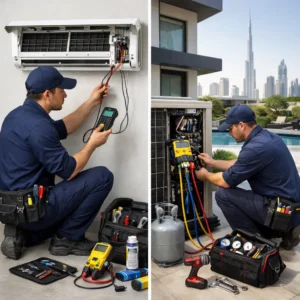
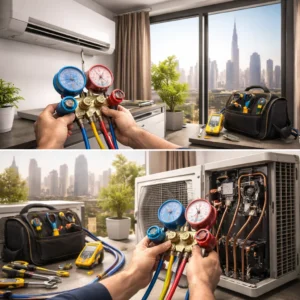
Even the best AC system will underperform if installed incorrectly. That’s why understanding proper AC installation practices is critical for long-term performance.
Popular AC Brands in UAE Market
Some commonly used AC brands in Dubai include:
- Daikin
- O General
- Mitsubishi Electric
- LG
- Samsung
These brands are known for reliability under high-temperature conditions.
AC Installation Cost in Dubai
The cost of AC installation depends on unit type, capacity, and installation complexity.
| Service Type | Estimated Price Range (AED) |
|---|---|
| Split AC Installation | 300 – 800 |
| Ducted AC Installation | 1,500 – 5,000+ |
| Central AC Installation | 5,000 – 15,000+ |
Note: These prices are slightly below average UAE market rates and may vary depending on complexity, materials, and site conditions.
Common Mistakes in AC Sizing
- Choosing AC based on price instead of size
- Ignoring sun exposure and insulation
- Over-sizing the unit
- Using generic global sizing rules
These mistakes often lead to poor performance and higher costs.
Why Correct Sizing Saves More Money
Proper AC sizing helps:
- Reduce electricity bills
- Improve cooling efficiency
- Extend AC lifespan
- Maintain indoor comfort
An incorrectly sized AC can increase costs over time.
When You Should Re-evaluate Your AC Size
- Room feels hot even when AC is running
- AC runs continuously without cooling
- Uneven cooling in different areas
- High electricity bills
These signs often indicate incorrect sizing or installation issues.
Think Beyond Just Room Size
AC installation is not only about room dimensions. It is about total heat load, airflow, and system efficiency.
If you are planning an AC installation or replacement, it is important to get the sizing right from the beginning. Incorrect sizing can lead to poor cooling, higher electricity bills, and unnecessary strain on the system. Over time, this can result in more frequent repairs and reduced lifespan of the unit. With the right approach, these issues can be avoided early. If you need clarity about your room requirements or AC capacity, you can use the WhatsApp or Call button on the top right to connect with the Bio On Air team and understand the most suitable setup for your space.
Conclusion
Choosing the correct ac installation room size in the UAE requires more than basic calculations. By considering UAE-specific conditions, proper formulas, and installation factors, you can ensure efficient cooling, lower energy costs, and long-term performance.