




The right ac fitting position affects much more than how cold a room feels. It determines how evenly air is distributed, how clean the indoor air remains, how much electricity the system consumes, how often repairs are needed, and how long the AC will last. Many cooling complaints—uneven temperature, weak airflow, water leaks, noise, or frequent breakdowns—are not caused by faulty parts but by poor positioning during installation. This guide explains, in a practical and easy-to-understand way, how to evaluate the correct AC fitting position so you can achieve consistent comfort, efficient performance, and long-term reliability.
Table of Contents
ToggleRecommended Mounting Height for Proper Cooling Performance
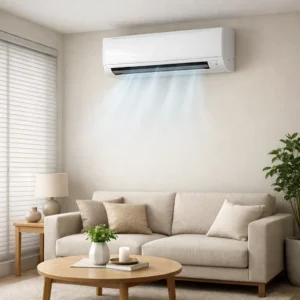
Mounting height is one of the most critical factors in AC fitting position. A wall-mounted split AC works by pulling warmer air from the room, cooling it, and then pushing cold air back out. If the unit is installed too low or too high, this airflow cycle becomes inefficient.
In most residential and office spaces, the recommended mounting height for a wall-mounted indoor unit is:
- Approximately 2.2 to 2.5 meters from the finished floor level
- At least 15–20 cm below the ceiling to allow proper air intake
Installing the AC too close to the ceiling restricts the return air intake, causing the unit to recycle already cooled air. This results in short cycling, uneven cooling, and unnecessary energy consumption. On the other hand, installing it too low can lead to cold air dropping directly onto occupants, creating discomfort and temperature imbalance.
The correct mounting height allows warm air to be drawn efficiently from the upper part of the room while distributing cooled air across the occupied zone. This balance is essential for both comfort and efficiency.
Required Clearances Around the Indoor Unit
Even if the mounting height is correct, insufficient clearance around the AC unit can severely reduce performance. An AC needs space to breathe.
Key clearance guidelines for indoor units include:
- Top clearance: Minimum 15–20 cm from the ceiling
- Side clearance: At least 10–15 cm on both sides
- Front clearance: No obstructions within 2–3 meters in the airflow direction
When these clearances are ignored, airflow becomes restricted. This can cause weak cooling, noisy operation, and higher strain on the fan motor. Over time, restricted airflow leads to dust accumulation inside the unit and increased maintenance needs.
Clearances are not just technical requirements; they directly influence how evenly the room cools and how quietly the AC operates.
Airflow Dynamics and Cold-Air Throw Direction
Understanding airflow dynamics is essential when deciding the best ac fitting position. Cold air is heavier than warm air, so it naturally moves downward. AC systems are designed to push cooled air outward and slightly upward so it can travel across the room before settling.
Key airflow principles to consider:
- The air outlet should face the longest open area of the room
- Air should not blow directly into corners or narrow passages
- The goal is to create a circulation loop, not a direct cold blast
If the AC is positioned incorrectly, cold air may fall too quickly, creating “cold spots” near the unit and “dead zones” elsewhere. These dead zones often feel warm or stuffy, even when the AC is running continuously.
Proper air throw direction ensures that cooled air reaches all parts of the room evenly, improving comfort and reducing runtime.
Avoiding Dead Zones and Uneven Cooling
Dead zones occur when airflow does not reach certain areas of the room. This is a common complaint in rooms with poor AC fitting position.
Common causes of dead zones include:
- AC facing a short wall instead of the room’s length
- Furniture blocking the airflow path
- Improper louver angle settings
To avoid dead zones, the AC should ideally be installed on a wall that allows air to travel across the widest part of the room. Louvers should be adjusted to distribute air horizontally before allowing it to descend.
Even with a powerful AC, poor positioning can make some areas uncomfortable. Correct placement often solves these issues without upgrading capacity.
Furniture, Curtains, and Obstruction Risks
Obstructions are one of the most overlooked issues in AC installation. Furniture placement and window treatments can drastically affect airflow.
Common obstruction mistakes include:
- Installing AC above wardrobes or cabinets
- Heavy curtains hanging directly in front of the unit
- Bookshelves or partitions blocking air circulation
These obstructions force cold air to bounce back toward the unit instead of circulating through the room. This reduces efficiency and may cause condensation issues inside the AC.
When evaluating ac fitting position, always consider the final furniture layout, not just the empty room.
Correct Wall Orientation Based on Room Shape
Room shape plays a major role in determining the best wall for AC installation. Square, rectangular, and irregular rooms all behave differently in terms of airflow.
General guidance includes:
- Rectangular rooms: install AC on the shorter wall to allow airflow along the length
- Square rooms: choose a wall that avoids direct airflow onto occupants
- Irregular rooms: prioritize the most frequently used area
The correct wall orientation helps distribute air evenly and avoids hot pockets. It also reduces the need for constant temperature adjustments.
Relationship Between Indoor and Outdoor Units
The ac fitting position is not only about the indoor unit. The relationship between indoor and outdoor units is equally important for system efficiency.
Key factors to consider include:
- Distance between indoor and outdoor units
- Vertical height difference
- Piping route complexity
Excessive distance or poor piping layout increases pressure loss and reduces cooling efficiency. It also puts extra stress on the compressor.
Distance Efficiency and Piping Layout Considerations
Most manufacturers specify maximum and minimum piping lengths. While longer piping is sometimes unavoidable, shorter and straighter routes are always better.
Good piping practices include:
- Minimizing bends and sharp turns
- Avoiding unnecessary vertical rises
- Using proper insulation throughout the piping length
Well-designed piping improves energy efficiency and reduces long-term wear.
Height Differences and Oil Return Protection
When there is a significant height difference between indoor and outdoor units, oil return becomes a concern. Compressors rely on oil circulation for lubrication.
If the AC fitting position creates excessive vertical separation without proper piping design, oil may not return efficiently to the compressor. This can lead to premature compressor failure.
Professional installation accounts for these factors to protect the system over time.
Practical Do’s and Don’ts for Indoor Unit Placement
Correct placement avoids many daily discomforts and long-term issues.
Do:
- Install AC away from direct sunlight
- Ensure unobstructed airflow
- Position for even room coverage
Don’t:
- Install above beds or seating areas where cold air blows directly
- Place near heat sources like ovens or electronics
- Install in high-traffic areas prone to vibration or impact
Drainage and Gravity Requirements
Drainage is often ignored until a leak occurs. Proper ac fitting position ensures that condensate water flows out naturally.
Key drainage requirements include:
- Correct drain slope direction
- No upward loops in the drain line
- Secure and insulated drainage piping
Improper drainage leads to water leakage, mold growth, and ceiling damage.
Leak Prevention, Condensation Control, and Noise Reduction
Correct positioning reduces condensation risks and vibration noise. Units installed on unstable walls or without vibration isolation may produce rattling sounds.
Good installation practices include proper wall anchoring, insulation, and anti-vibration pads.
Quick Calibration Checklist for AC Fitting Position
This checklist helps homeowners and installers evaluate whether an AC position is optimal:
- Is the unit mounted at the recommended height?
- Are all required clearances met?
- Is airflow unobstructed and evenly distributed?
- Is drainage sloped correctly with no leaks?
- Is the indoor-outdoor piping layout efficient?
If most answers are “yes,” the ac fitting position is likely suitable for long-term performance.
When AC Positioning Should Be Handled by Professionals
Incorrect positioning can lead to poor cooling, higher energy bills, water leaks, and premature system failure. Bio On Air helps ensure proper AC positioning by evaluating airflow, room layout, drainage, and piping efficiency. Addressing placement early prevents costly corrections later. If you are planning installation or experiencing recurring issues, you can use the WhatsApp or Call button at the top right of this page to discuss your setup with our team.
Conclusion
The correct ac fitting position is one of the most important factors in achieving efficient cooling, healthy indoor air, and long system lifespan. From mounting height and clearances to airflow direction, drainage, and indoor-outdoor coordination, every detail matters.
Many AC problems are not caused by defective equipment but by poor positioning. By understanding and applying these principles, homeowners and installers can avoid discomfort, reduce energy consumption, and prevent recurring issues. Proper positioning is not an upgrade—it is the foundation of reliable air conditioning performance.