




Many homeowners search for how ac system works when their unit behaves unexpectedly—cooling feels weak, water drips from the drain pipe, or the AC runs longer than usual. Understanding how an AC system actually works helps you make better decisions, avoid common misunderstandings, and recognize problems early before they become expensive repairs.
Table of Contents
ToggleAC Does Not Create Cold Air – It Removes Heat
The most important concept to understand is this: an air conditioning system does not “create” cold air. Instead, it removes heat from inside your home and transfers it outside.
Think of it like moving heat rather than producing cold. If you place a hot cup of coffee on a table, the coffee eventually cools down. The heat did not disappear—it moved into the surrounding air. An AC system works on the same idea, but in a controlled and continuous way.
When your AC runs, it is actively collecting heat from indoor air and carrying it outdoors. The air feels cooler because the heat has been removed from it. This simple principle explains most AC behavior and helps clear up many common misconceptions.
The Big Picture – The Refrigeration Cycle in Simple Terms
The process that allows heat removal is called the refrigeration cycle. While the technical explanation involves thermodynamics, pressure, and phase changes, the concept can be understood using a simple analogy.
Imagine refrigerant as a delivery vehicle whose job is to pick up heat inside your home and deliver it outside. It continuously travels in a loop, changing its state along the way so it can absorb and release heat efficiently.
This cycle involves four main components working together:
- Evaporator coil
- Compressor
- Condenser coil
- Expansion device
Each component plays a specific role in moving heat from indoors to outdoors.
The Four Main Components and Their Roles
1. Evaporator Coil – The Heat Absorber
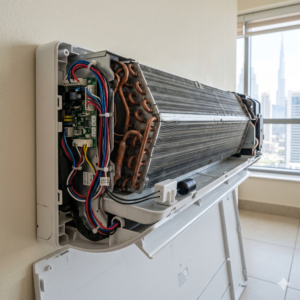
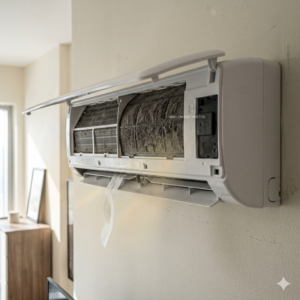
The evaporator coil is located inside your home, usually within the indoor unit. This is where heat absorption happens.
Warm indoor air passes over the cold evaporator coil. Inside the coil, refrigerant is in a low-pressure, low-temperature liquid state. As warm air touches the coil, heat transfers into the refrigerant. The refrigerant absorbs that heat and changes from liquid to gas.
This phase change—from liquid to gas—is essential. When a liquid evaporates, it absorbs heat. This is the same reason sweat cools your skin when it evaporates.
2. Compressor – The Pressure Builder
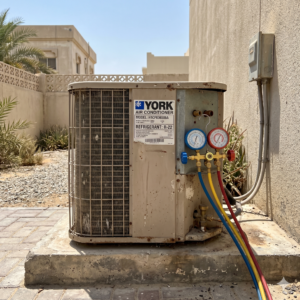
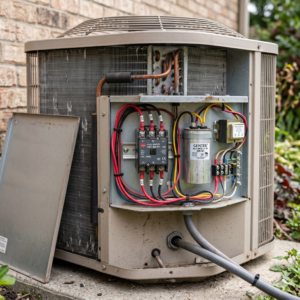
After absorbing heat, the refrigerant is now a low-pressure gas. It travels to the compressor, located in the outdoor unit.
The compressor squeezes the gas, increasing its pressure. When pressure increases, temperature rises. The refrigerant becomes a high-pressure, high-temperature gas.
This step is important because heat naturally moves from warmer areas to cooler ones. By increasing the refrigerant’s temperature above outdoor temperature, the system ensures that heat can be released outside.
3. Condenser Coil – The Heat Releaser
The hot, high-pressure refrigerant gas moves into the condenser coil, also located in the outdoor unit.
Outdoor air blows across this coil. Because the refrigerant is now hotter than the outdoor air, heat transfers from the refrigerant to the outside air. As it loses heat, the refrigerant changes back into a liquid.
This is the second phase change—from gas back to liquid. During this process, the heat collected from inside your home is released outdoors.
4. Expansion Device – The Pressure Reducer
Now that the refrigerant is a high-pressure liquid, it passes through an expansion device. This component reduces the pressure quickly.
When pressure drops, temperature also drops. The refrigerant becomes a cold, low-pressure liquid again, ready to return to the evaporator coil and repeat the cycle.
This continuous loop is how the AC keeps removing heat from your home.
Step-by-Step Flow of Refrigerant
Let’s simplify the full refrigerant journey step by step:
- Cold, low-pressure liquid enters the evaporator coil.
- It absorbs heat from indoor air and turns into gas.
- The gas moves to the compressor and gets compressed.
- High-pressure hot gas moves to the condenser coil.
- Heat is released outdoors and the gas becomes liquid.
- The liquid passes through the expansion device and becomes cold again.
- The cycle repeats until the thermostat setpoint is reached.
This constant phase change between liquid and gas is what makes heat transfer possible.
Airflow Process – How Air Circulates Inside Your Home
Understanding refrigerant alone is not enough. Air movement is equally important.
The airflow process includes three main steps:
- Return air: Warm indoor air is pulled into the system through return vents.
- Heat absorption: Air passes over the evaporator coil where heat is removed.
- Supply air: Cooler air is pushed back into rooms through supply vents.
This cycle continues repeatedly. The same indoor air is cooled gradually as it circulates multiple times through the system.
Cold Side vs Hot Side – Visual Flow Logic
It helps to divide the AC system into two sections:
- Cold side: Indoor unit with evaporator coil absorbing heat.
- Hot side: Outdoor unit with compressor and condenser releasing heat.
Heat moves from the cold side to the hot side, even if outdoor air feels hot to you. The refrigerant is made hotter than outdoor air through compression, allowing heat transfer to occur.
Why Water Drips – Understanding Dehumidification
When warm air passes over the cold evaporator coil, not only heat but also moisture is removed.
Warm air holds water vapor. When air cools, it cannot hold as much moisture. The excess moisture condenses into water droplets on the coil. This is similar to water forming on a cold glass.
The condensed water flows into a drain pan and exits through a drain line. This is why you may see water dripping outside.
This dehumidification process is important because high humidity makes a room feel warmer than it actually is.
Continuous Cooling Cycle and Thermostat Behavior
The thermostat controls when the AC runs. It measures indoor temperature and compares it to the setpoint.
When indoor temperature is above the setpoint, the AC runs. Once the temperature reaches the setpoint, it stops.
A common misunderstanding is believing that lowering the thermostat far below the desired temperature makes the room cool faster. It does not.
The AC cools at a fixed rate. Setting the thermostat much lower only makes it run longer, not faster. This can increase energy usage unnecessarily.
Connecting System Operation to Common Problems
Understanding how an AC system works helps explain common issues:
- Low refrigerant: The system cannot absorb enough heat, leading to weak cooling.
- Dirty evaporator coil: Heat transfer is reduced.
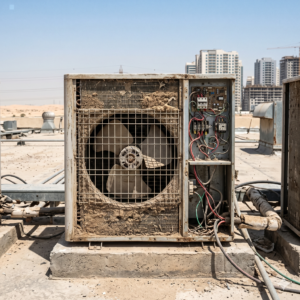
- Dirty condenser coil: Heat cannot release efficiently outdoors.
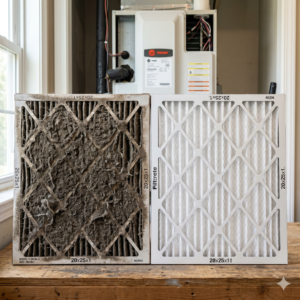
- Restricted airflow: Insufficient air passing over coils reduces cooling performance.
- Compressor issues: Pressure differences are not maintained properly.
- Thermostat misunderstanding: Incorrect settings lead to longer run times.
Each problem relates directly to heat transfer or airflow disruption.
Why AC Runs Longer During Extreme Heat
In very hot weather, the difference between indoor and outdoor temperature is greater. More heat enters the building from outside.
The AC must remove heat continuously to maintain the setpoint. This explains why systems run longer during peak summer.
This is normal behavior, not necessarily a malfunction.
Energy Efficiency and System Balance
Efficiency depends on smooth heat transfer and proper airflow. When coils are clean, refrigerant levels are correct, and airflow is unrestricted, the system operates efficiently.
Any imbalance increases workload. The compressor runs longer, electricity consumption rises, and wear increases.
Practical Understanding for Homeowners
You do not need to master thermodynamics to understand your AC. Remember these key ideas:
- The system removes heat; it does not create cold.
- Refrigerant changes state to absorb and release heat.
- Airflow is as important as refrigerant flow.
- Moisture removal is part of the cooling process.
- The thermostat controls duration, not speed.
When Professional Attention Is Necessary
If cooling is weak, airflow is uneven, water leaks persist, or the system runs constantly without reaching the setpoint, professional inspection is recommended. Bio On Air helps address these issues through proper diagnosis, safe handling of refrigerant and electrical components, and clear explanations of what is happening inside your system. Early action prevents efficiency loss, unhealthy indoor air, and more expensive component damage. You can use the WhatsApp or Call button at the top right of this page to discuss your AC behavior with our team.
Conclusion
Understanding how ac system works gives you control and clarity. An AC system removes heat through a continuous refrigeration cycle involving phase changes, pressure differences, and airflow circulation. The evaporator absorbs heat, the compressor increases pressure, the condenser releases heat outdoors, and the expansion device resets the cycle. At the same time, moisture is removed, and air circulates until the thermostat setpoint is reached.
When you understand this flow—heat in, heat out—you can better interpret symptoms, avoid common misconceptions, and recognize when professional support is needed. Practical knowledge reduces confusion and helps maintain comfort, efficiency, and healthy indoor air throughout the year.